Stefan Harries: What CAESES Does

What exactly is CAESES® and what does it? This short interview with one of the founders from FRIENDSHIP SYSTEMS, Dr. Stefan Harries, will give you some quick insights:
Q: What is the most important functionality that CAESES provides?
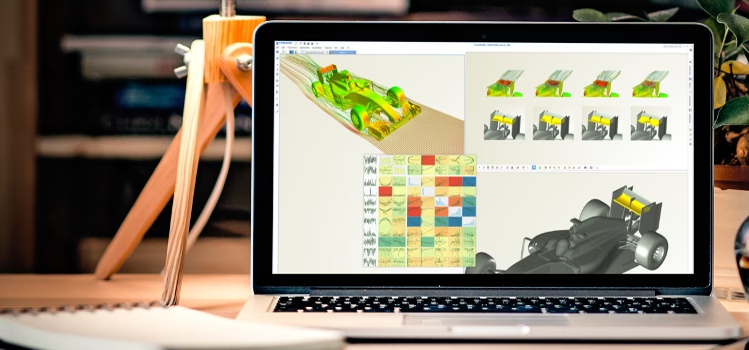
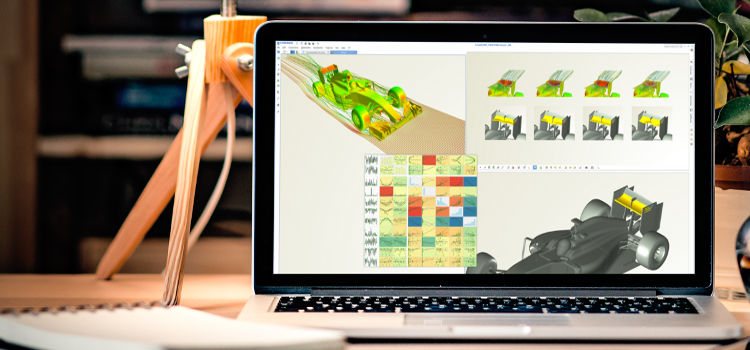
“Most importantly, CAESES® provides you with robust variable geometry for simulations. Whenever you need fair and watertight geometry, in particular for CFD simulations, CAESES® gives you the methods to model complex shapes with as few parameters as possible.”
Q: Is CAESES a CAD software?
“CAESES is a specialized CAD software for variation and simulation. But it is not standard CAD which typically aims at production. CAESES users are often simulation experts that want to model and parameterize geometry themselves. And they want to quickly generate variants of their designs for improved performance.”
Q: Does CAESES come with its own CFD code?
“No, CAESES® does not have any Computational Fluid Dynamics (CFD) code of its own. Rather, with CAESES® you connect your simulation-ready CAD to any external CFD code that can be run in batch-mode.”
What is CAESES
Q: Is CAESES a process integration and design optimization (PIDO) software?
“Yes, with CAESES® you can connect to any external tool, even across platforms, and build process chains for automation and optimization. However, different to any standard PIDO solution, CAESES® also offers you a full range of parametric modeling tools.”
Q: What does CAESES stand for?
“CAESES® stands for Computer Aided Engineering System Empowering Simulation. In this sense it is a CAE environment. It is used for simulation-driven design in which many variants are studied by means of simulation in order to identify the best possible solution.”
All details about the CAD and optimization platform CAESES® can be found on the product pages. Feel free to get in touch with us if you are interested in discussing a possible CAESES® use in the context of your application.