Simulation- and data-driven design without the bottlenecks
Variable geometry, automation, and optimization in one platform.
- Reduce late changes
- Automate simulation workflows
- Explore larger design spaces faster
All core design functionalities in one platform
Flexible parametric geometry modeling
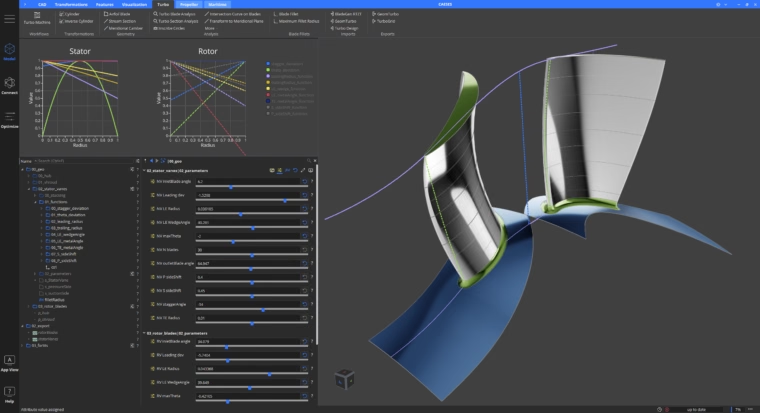
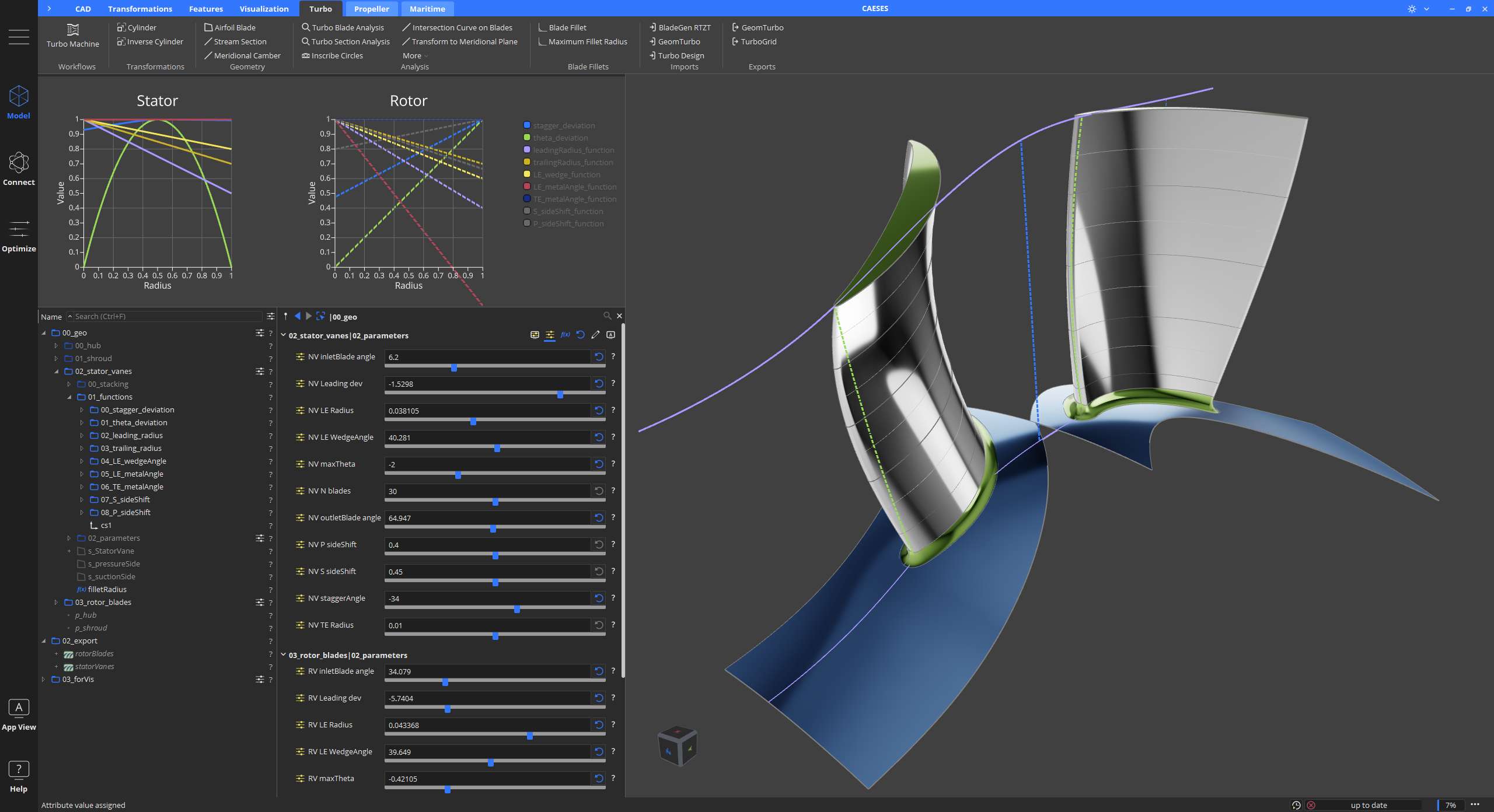
CAESES provides a powerful parametric modeling environment built for simulation-driven design. Based on flexible NURBS geometry, it enables stable, highly adaptable models that support automated design studies, optimization, and data-driven workflows – even for complex freeform shapes.
Efficient parameterization
CAESES enables intelligent parameterization of even highly complex, freeform geometries. Instead of relying on large numbers of variables, models are defined using a minimal set of meaningful, descriptive parameters – making them easier to control, understand, and optimize.
Robust geometry variation
Models remain stable and reliable under extensive variation. Geometry regenerates consistently without failures or defects, allowing you to run large-scale design studies and optimization processes with confidence.
Fully customizable modeling
There are no predefined templates or black-box models. Every aspect of the model and its parametric logic can be tailored to your specific requirements, giving you full control over how geometry is defined and behaves.
Integrated constraint handling
Geometrical constraints – such as manufacturing or packaging requirements – can be embedded directly into the model. This ensures that all generated design variants remain feasible and reduces the need for manual rework.
Seamless simulation process integration
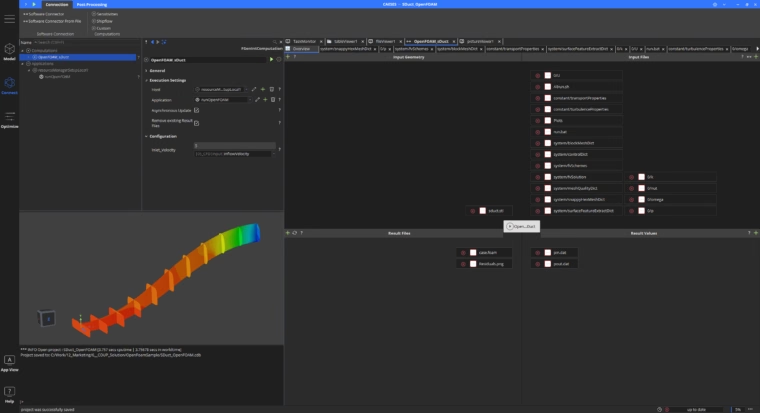
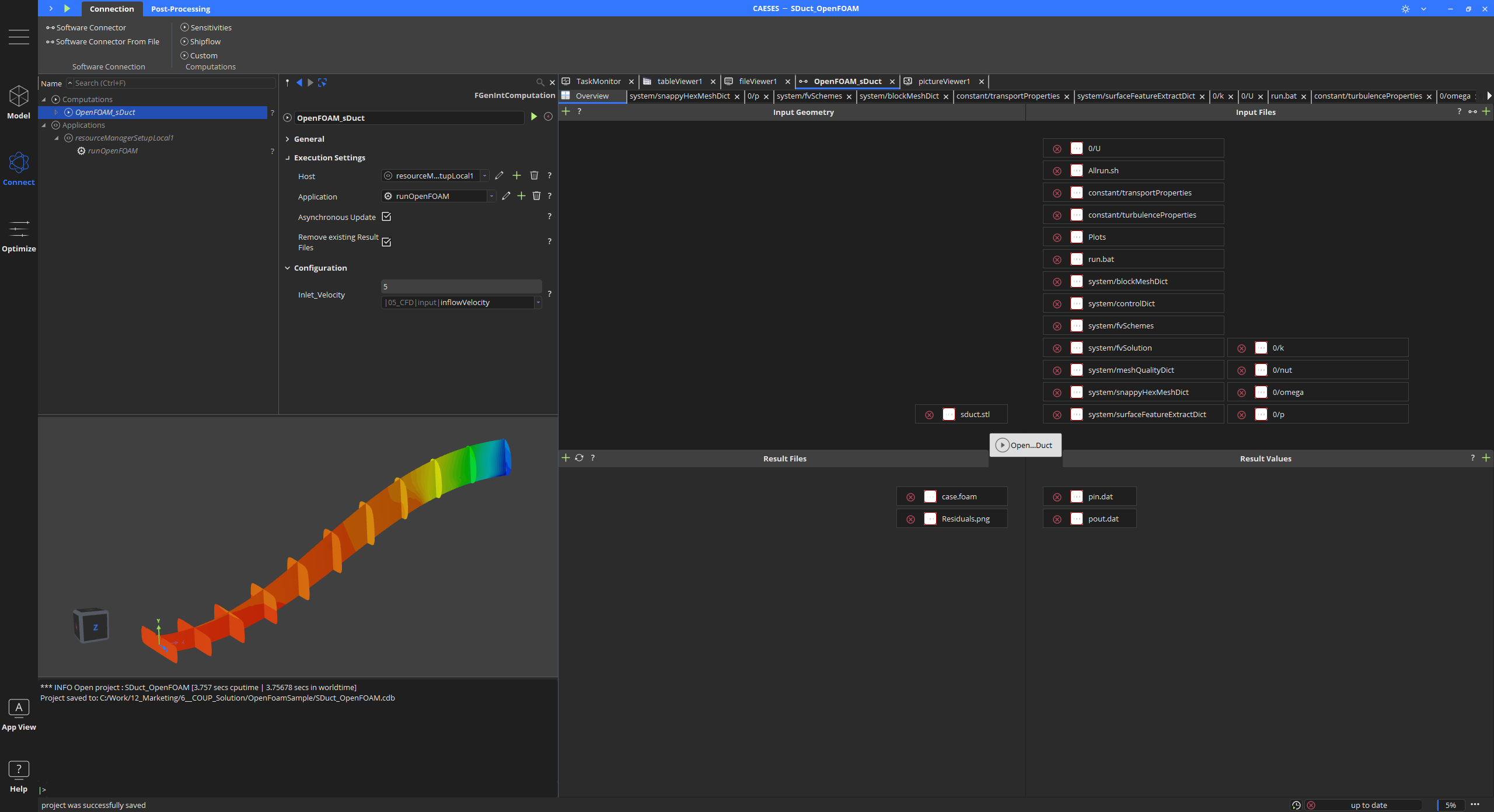
CAESES connects geometry generation with simulation and analysis tools in a fully automated workflow. Through its flexible software connector framework, it integrates CFD, FEA, meshing, and in-house applications into a single environment – enabling efficient design studies, optimization, and automated engineering processes.
Rapid software integration
Connect commercial, open-source, or proprietary tools with minimal effort. Any application that supports batch execution can be integrated into CAESES, allowing existing simulation workflows to be automated without modifying the underlying software.
Automated workflow execution
Create end-to-end process chains that automatically handle geometry generation, meshing, simulation, and post-processing. CAESES orchestrates all workflow steps, reducing manual effort and ensuring consistent execution across large design studies.
Reliable data exchange
Input parameters, geometry files, simulation settings, and results are transferred automatically between connected tools. This eliminates repetitive data handling tasks, reduces errors, and improves overall process efficiency.
Integrated result evaluation
Simulation results can be imported, analyzed, and visualized directly within CAESES. Automated extraction of key performance indicators provides immediate feedback and supports faster design decisions during optimization and exploration.
Automated design exploration and shape optimization
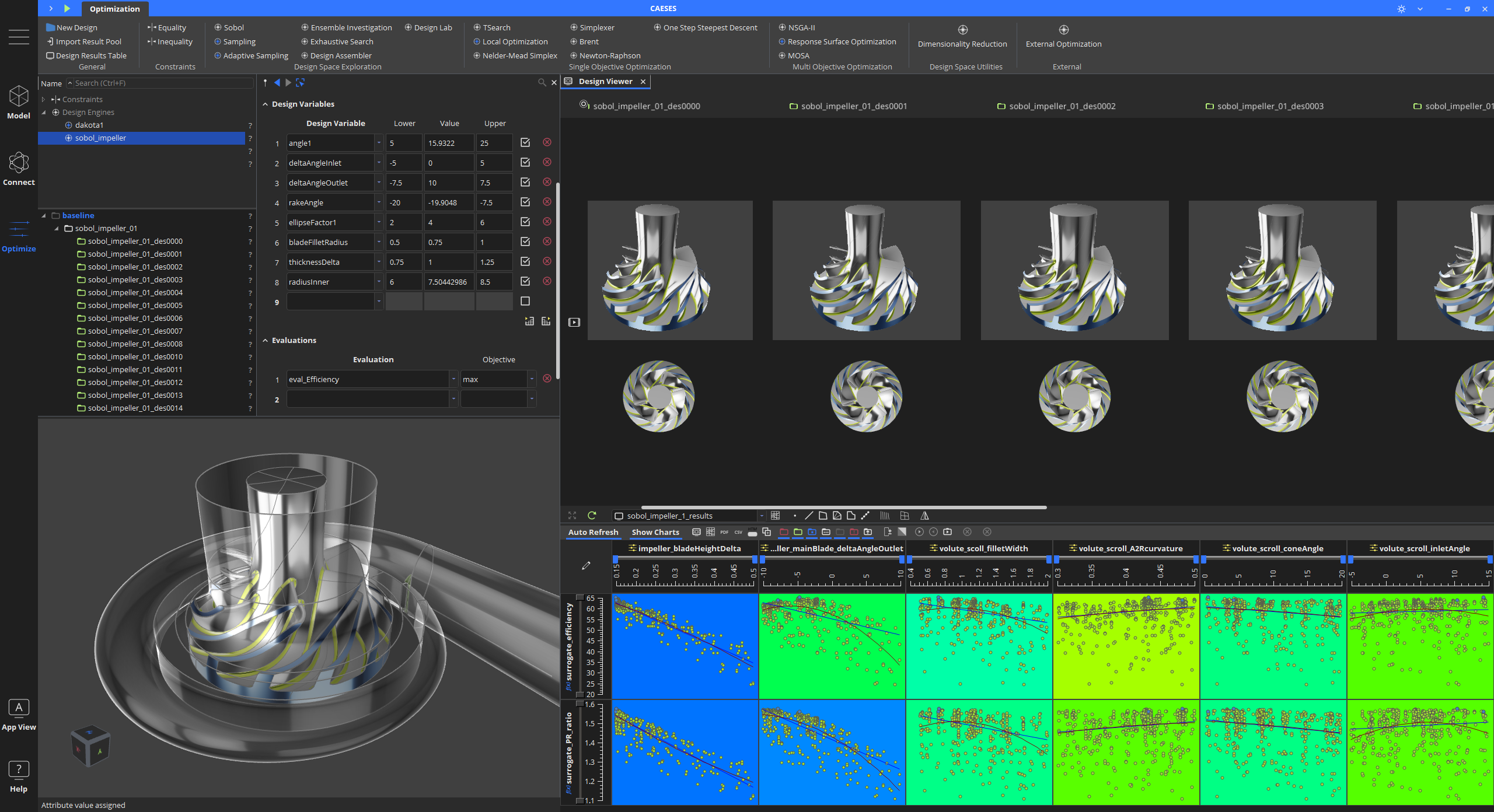
CAESES enables engineers to systematically explore design alternatives and identify optimal solutions through integrated optimization technologies. From parameter studies to advanced multi-objective optimization, it helps you make better design decisions based on simulation results rather than trial and error.
Advanced optimization strategies
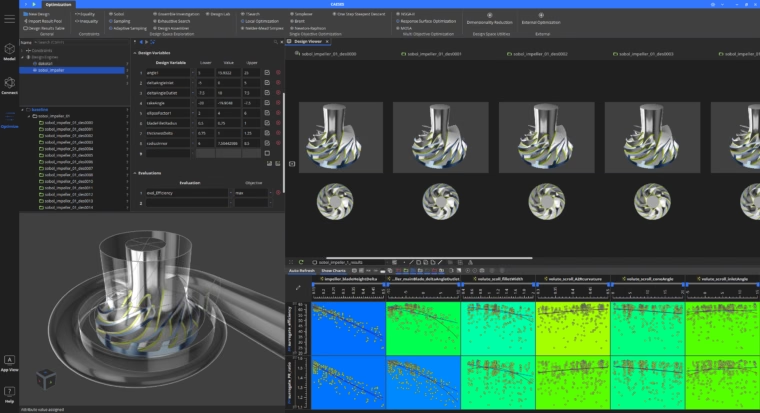
Apply a wide range of optimization methods, including parameter studies, sensitivity analyses, single-objective, and multi-objective optimization. Built-in algorithms and surrogate modeling techniques help accelerate the search for high-performing designs.
Efficient design space exploration
Automatically generate, evaluate, and compare large numbers of design variants. CAESES helps uncover performance trends, understand parameter influences, and identify promising regions of the design space with minimal manual effort.
Integrated variant management
All design candidates, simulation results, objectives, and constraints are managed in a single environment. Interactive comparison tools and result visualizations make it easy to assess alternatives and select the best-performing solutions.
Open optimization ecosystem
Use the built-in optimization capabilities or connect CAESES to external optimization platforms. Its flexible architecture allows you to leverage existing optimization tools while benefiting from robust geometry generation and automated workflow execution.
Advanced data analysis and surrogate model intelligence
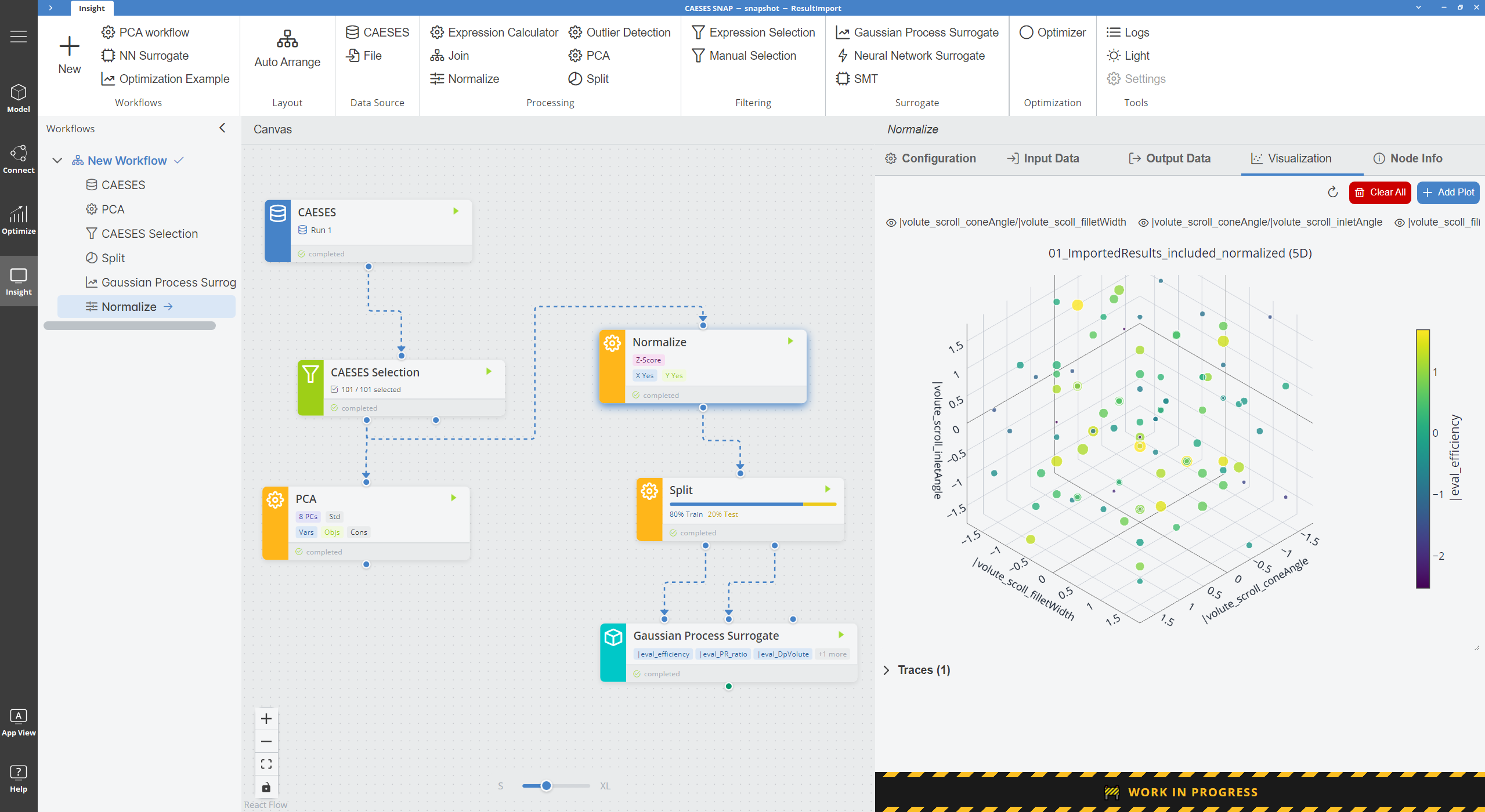
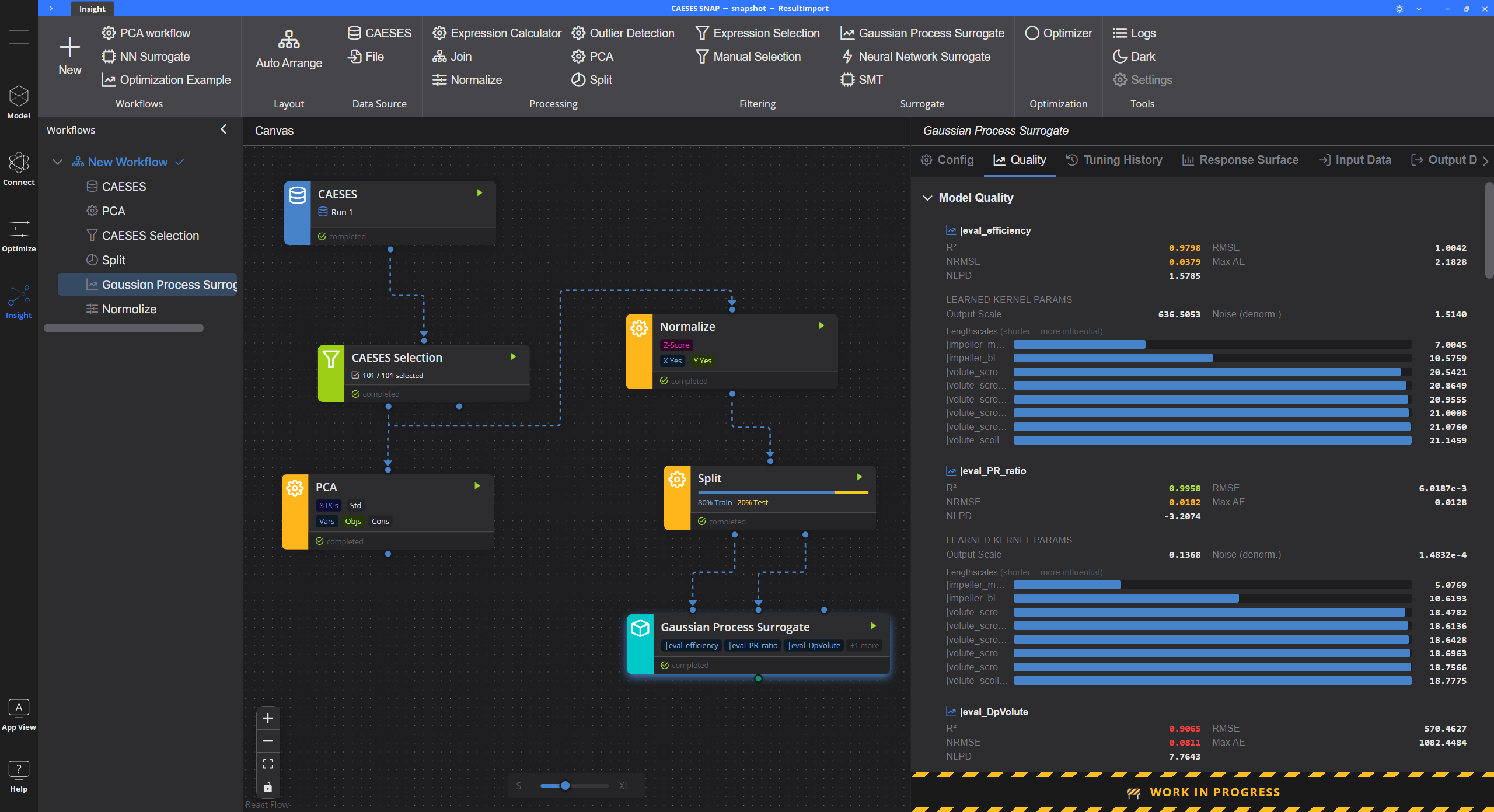
CAESES Insight extends simulation-driven design by combining data analysis, visualization, and surrogate modeling capabilities in one environment. It enables engineers to evaluate large design spaces, understand design trends, and use simulation data to support faster and more informed decisions.
Interactive design and results analysis
Explore simulation and optimization results using interactive visualization methods. Design variables, performance values, and generated variants can be filtered, compared, and analyzed to identify relationships and trends within the design space.
Surrogate model generation
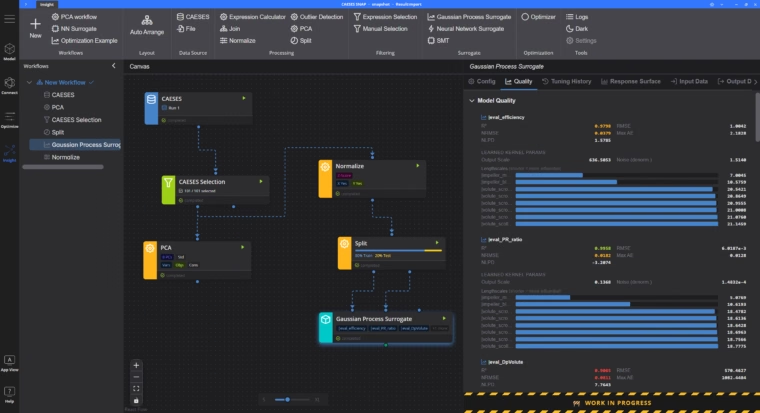
Create predictive models based on existing simulation data to approximate design performance. These models provide fast evaluations of new design variants and reduce the need for repeated high-fidelity simulations.
Surrogate model refinement
Improve prediction accuracy by analyzing model behavior, tuning, and adding targeted simulation data where needed. CAESES Insight supports iterative refinement to build more reliable surrogate models for design exploration.
Integrated data-driven workflows
Combine geometry, simulation results, optimization data, and surrogate models within a connected workflow. CAESES Insight helps engineers move from simulation results to design understanding and accelerated exploration.
Additional software
highlights
Simulation-ready by design
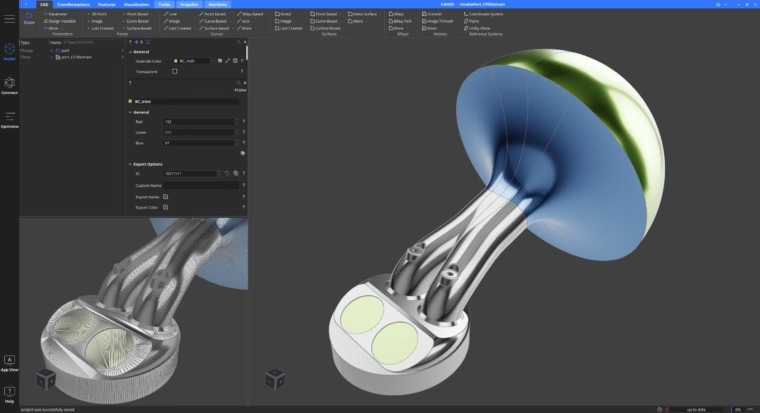
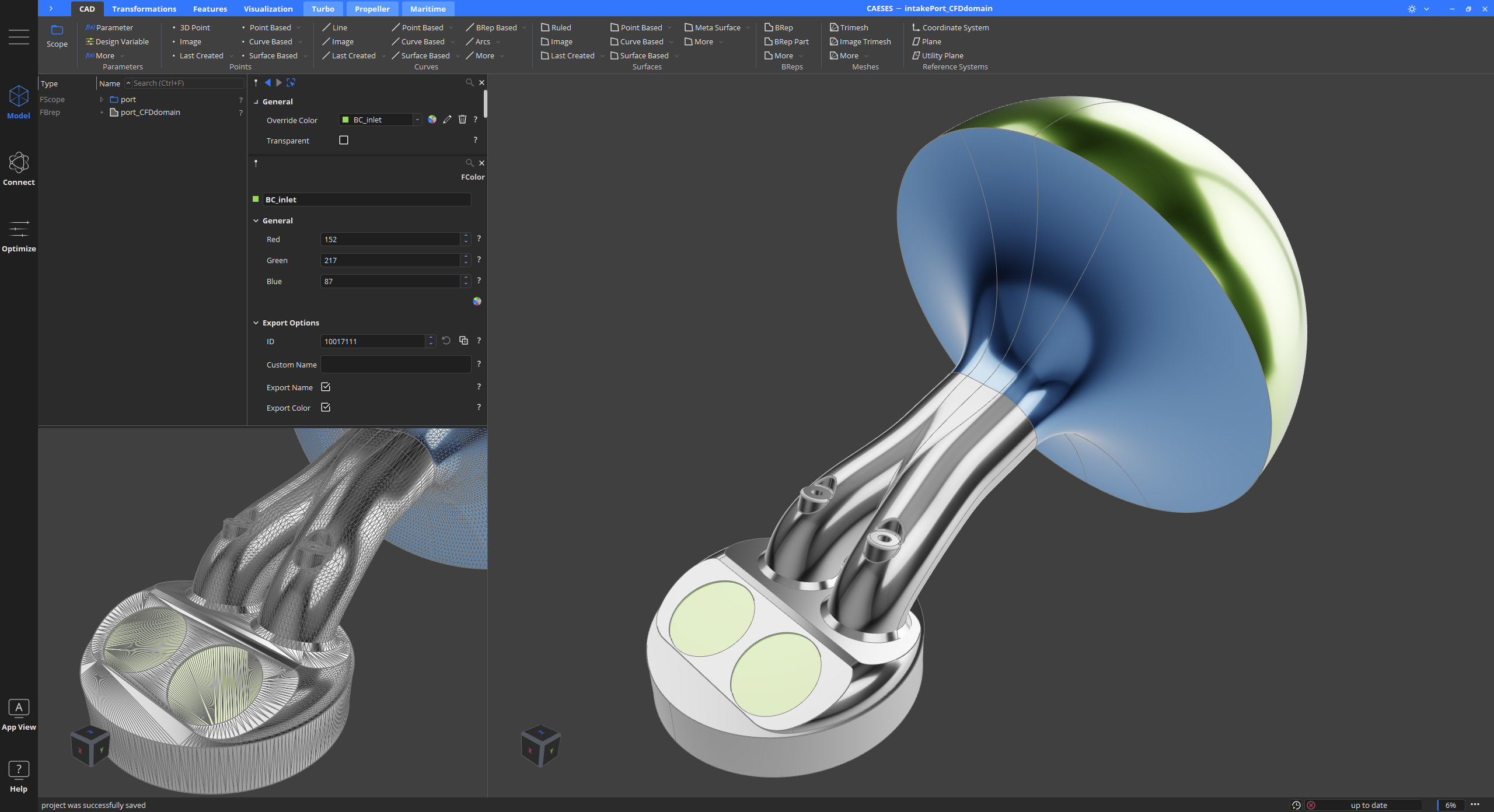
CAESES generates clean, watertight geometry that is ready for automated meshing and simulation. Persistent patch identifiers, customizable surface names, and per-patch triangulation settings are preserved throughout geometry variation, while integrated healing, snapping, and repair tools ensure robust exports – even for imported CAD models.
This enables one-time simulation preprocessing that remains valid for all generated design variants, significantly reducing manual effort and ensuring reliable automated analysis and optimization.
Shape deformation and morphing
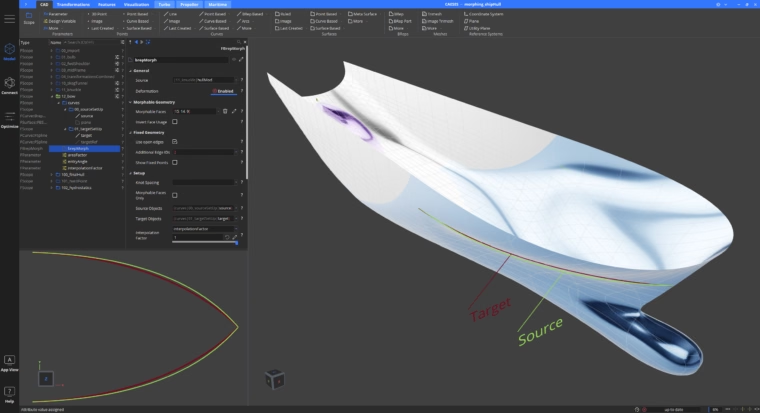
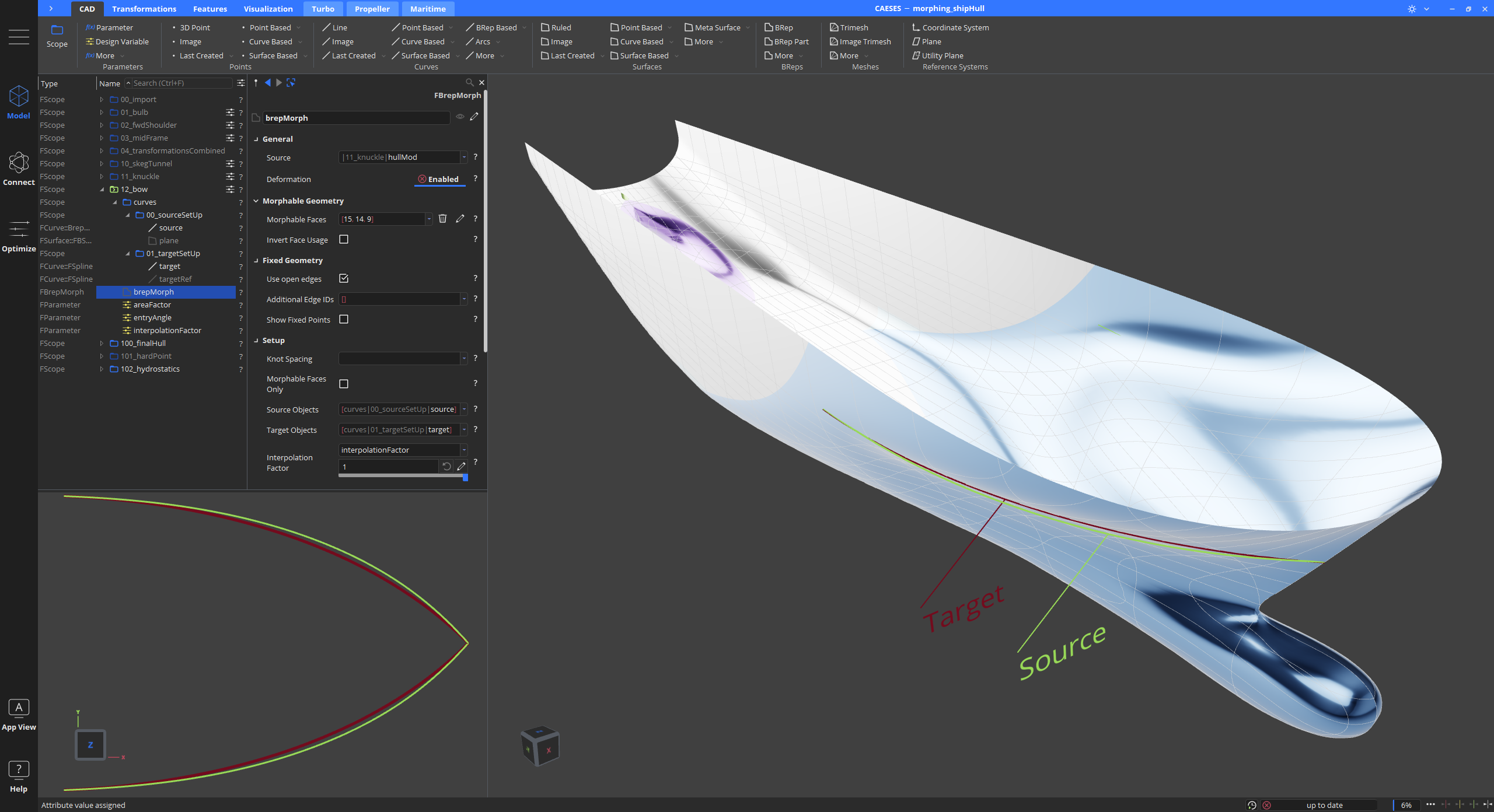
Alternatively to fully-parametric modeling, CAESES provides deformation and morphing tools for imported data, such as NURBS geometries or surface meshes. The methods include Free-Form Deformation (FFD) using control boxes and Radial Basis Function (RBF) morphing based on translation vectors or couples of source and target geometries.
This enables rapid design exploration and optimization of existing geometries, significantly reducing modeling effort while maintaining compatibility with automated workflows.
Powerful scripting
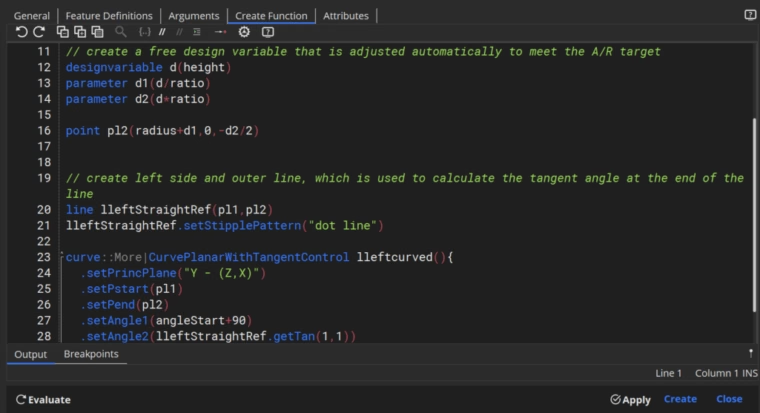
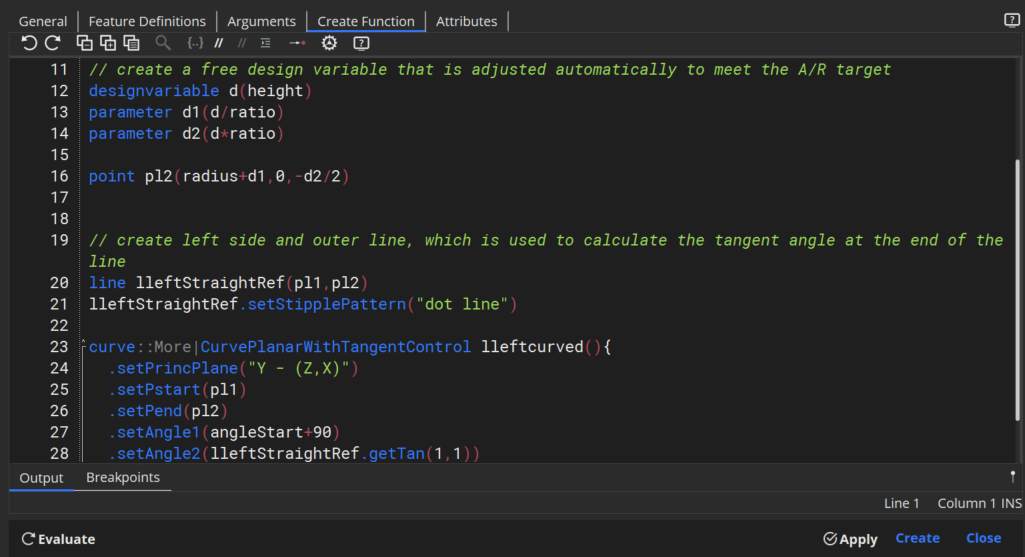
With feature programming, CAESES includes a powerful scripting environment that enables users to automate modeling tasks, create custom functions or exports, and extend software functionality to match specific engineering workflows. In addition, CAESES can run in batch mode fully controlled by externally generated scripts.
This provides maximum flexibility for implementing company-specific processes, reducing manual effort, and integrating CAESES into complex simulation-driven development processes.
Custom templates
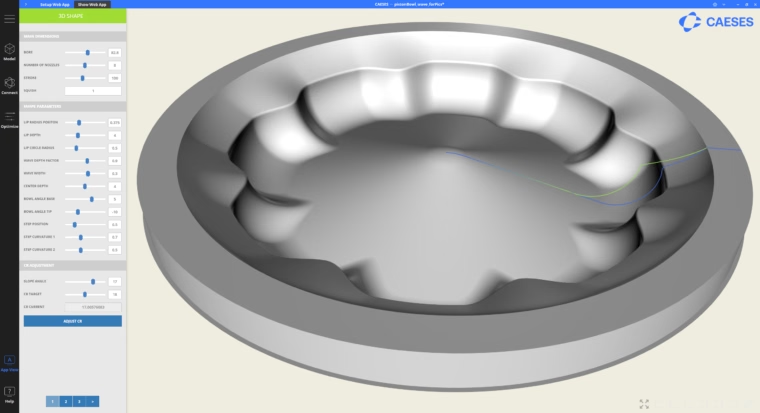
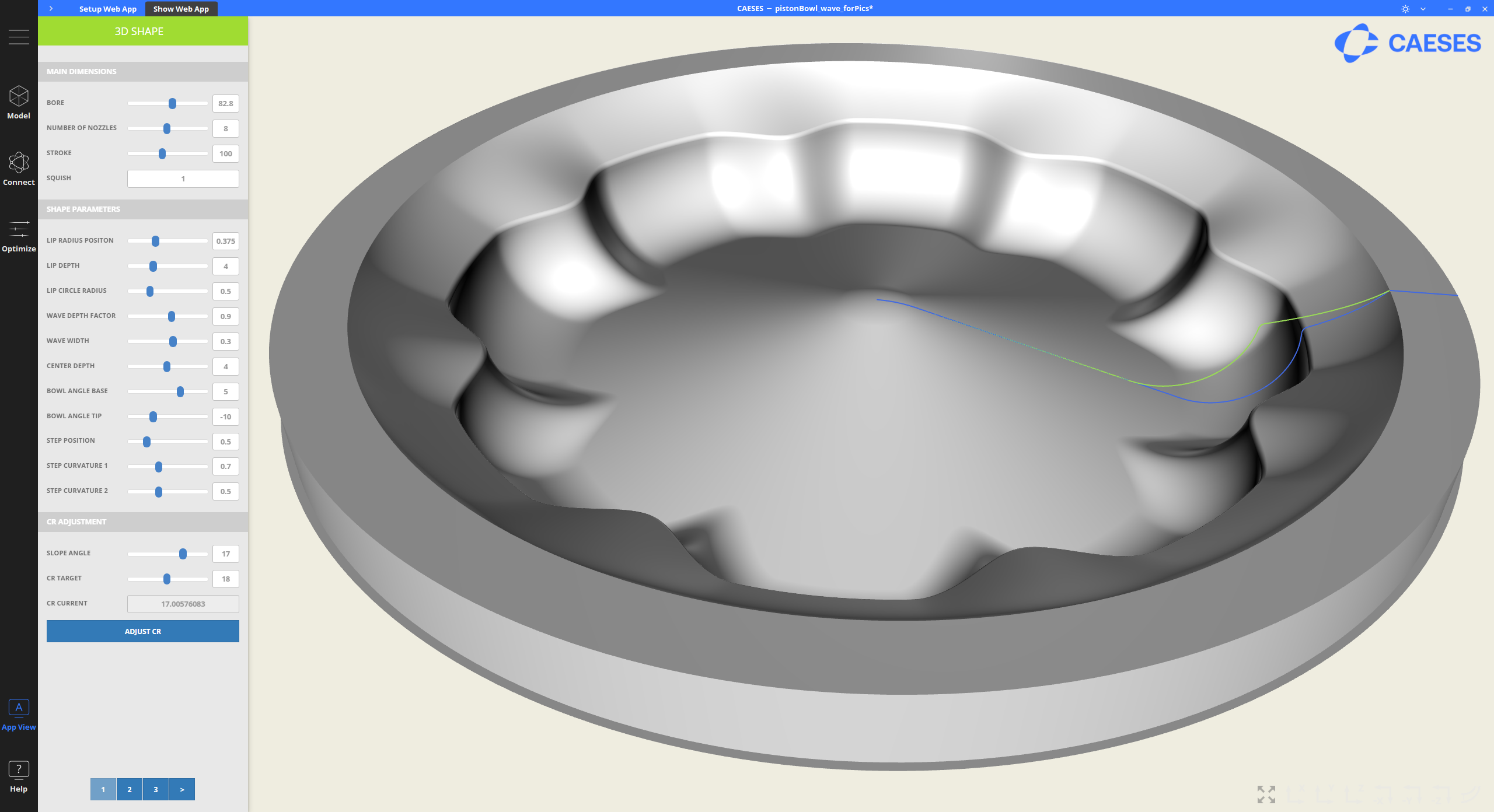
CAESES provides the generation of custom templates that wrap parametric models, workflows, and simulation setups into a simplified user interface tailored to a specific application. These templates can be accessed by users without expertise in using CAESES through web-based interfaces and executed offline or online.
This enables simulation-driven design capabilities to be deployed across teams, standardizes engineering workflows, and makes advanced automation accessible to both experts and occasional users.
Why CAESES
Stable geometry
In parametric engineering workflows, geometry needs to remain consistent while inputs change. Ensuring robustness across design variations is a key requirement for reliable simulation and automated evaluation.
Less parameters
As geometries become more complex, the number of parameters required to describe them can increase significantly. Structuring models in a meaningful way helps keep them manageable and focused on the actual design intent.
Automated workflows
Typical CAE processes involve time-consuming steps, including geometry preparation, meshing, and simulation setup. Bringing these steps into an automated workflow supports smoother transitions and reduces manual coordination effort.
Usable design results
Optimization generates a wide range of solutions, which still need to align with practical constraints such as manufacturing, and integration requirements. Considering constraints throughout the process ensures downstream usability of the results.
Fast automated iterations
Design exploration benefits from rapid iteration cycles, where models can be updated and evaluated repeatedly with minimal friction. Reducing manual intervention helps maintain momentum throughout the analysis process.
Design insights
Understanding relationships between design parameters and performance is not always straightforward. Thorough exploration and structured analysis support clearer interpretation and more informed design decisions.
FAQs
Is CAESES a CAD system?
CAESES includes powerful geometry modeling capabilities, but it is not a traditional CAD system focused on manufacturing drawings or production design. Instead, it is a highly specialized CAD tool with a focus on robust geometry variation for the purpose of design exploration and optimization.
Why would I need an additional CAD system?
The handling of geometry in the context of automated design studies and optimization is often a serious bottleneck with traditional CAD systems, which are focused on other tasks. Typical symptoms are models breaking under variation, violation of constraints, too many parameters, or the necessity for manual intervention in the setup of simulation processes.
Is CAESES an optimization software?
Yes. CAESES includes integrated methods for parameter studies, Design Space Exploration (DSE), response surface methods, and shape optimization workflows.
Can CAESES work with external optimization software?
Yes. CAESES can be integrated with optimization platforms such as HEEDS, Dakota, optiSLang, Optimus, and modeFRONTIER as a robust geometry engine.
Is CAESES a simulation tool?
No, CAESES does not include any simulation solvers. Instead, it integrates with external CFD and other simulation tools to automate geometry generation, meshing, simulation execution, design exploration, and optimization workflows.
Which simulation software can CAESES work with?
CAESES can be connected to virtually any simulation software through customizable workflows. It is commonly used with CFD, FEA, electromagnetic, and other engineering simulation tools, enabling fully automated optimization processes across a wide range of applications.
What is data-driven engineering, and how does CAESES support it?
Data-driven engineering uses simulation and experimental data to better understand design behavior, identify trends, and make informed engineering decisions. The CAESES Insight module provides powerful tools to analyze, filter, and visualize engineering datasets, helping engineers extract actionable insights from design studies and optimization results. By combining simulation-driven design with advanced data analytics, CAESES enables faster and more informed product development.
What is a surrogate model, and why is it useful in engineering optimization?
A surrogate model is a mathematical approximation of a computationally expensive simulation. Instead of running thousands of CFD or FEA analyses, engineers can use surrogate models to predict performance almost instantly, enabling rapid design exploration and optimization. CAESES Insight supports the generation, validation, and comparison of surrogate models, making it easier to accelerate optimization workflows while maintaining predictive accuracy.
How does CAESES Insight improve the quality of engineering data?
CAESES Insight helps engineers prepare high-quality datasets by automatically filtering invalid results, identifying outliers, merging data from multiple studies, and visualizing relationships between design variables and performance metrics. It also supports iterative surrogate model training and automated hyperparameter tuning to improve prediction accuracy with minimal manual effort. This allows engineering teams to build more reliable models and gain deeper insights from their simulation data.
Does CAESES support Linux and HPC environments?
Yes. CAESES is available for Linux and supports batch-mode workflows for HPC and distributed computing environments.