New Paper on Faster Hydrodynamic Optimization of a Catamaran
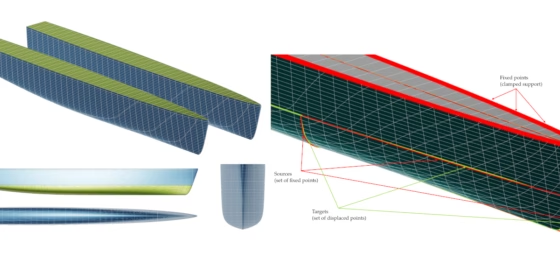
A new paper on “Application of Radial Basis Functions for Partially-Parametric Modeling and Principal Component Analysis for Faster Hydrodynamic Optimization of a Catamaran” by FRIENDSHIP SYSTEMS authors Stefan Harries and Sebastian Uharek has been published in the Journal of Marine Science and Engineering (JSME) – Special Issue: Hydrodynamic Design of Ships.
The paper shows the application of a flexible partially-parametric modeling approach on the basis of radial basis functions (RBF) for the modification of an existing hull form. Since the RBF approach may potentially introduce quite a few degrees-of-freedom (DoF), a principal component analysis (PCA) is utilized to reduce the dimensionality of the design space. PCA allows the deliberate sacrifice of variability in order to define variations of interest with fewer variables. The aim of combining RBFs and PCA is to make simulation-driven design (SDD) easier and faster to use.
Open Access to the Paper
This article has open access and can be read as a full-text version here:
More Information
Shape morphing allows you to easily import an existing geometry model and reshape your design with regards to the flow and structural performance. Read our latest blog post “Fast and Efficient Geometry Optimization with Morphing” for a comparison of the different morphing approaches in CAESES 5 and how it offers intuitive and exact shape modifications that can be set up in a matter of minutes.