CAESES 5.4 released: extended maritime workflows and new infrastructure capabilities
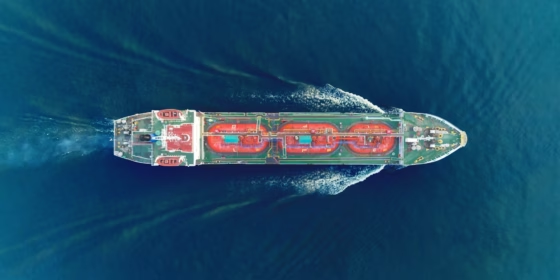
With CAESES 5.4, FRIENDSHIP SYSTEMS delivers the next step in the evolution of CAESES, further expanding the maritime design functionality introduced with CAESES 5.3 while also introducing powerful new features that benefit all CAESES users. The new release provides even more flexibility and support for naval architects, as well as improvements in geometry modeling, parameterization, and computational workflows.
Extended Component-Based Ship Modeling Capabilities
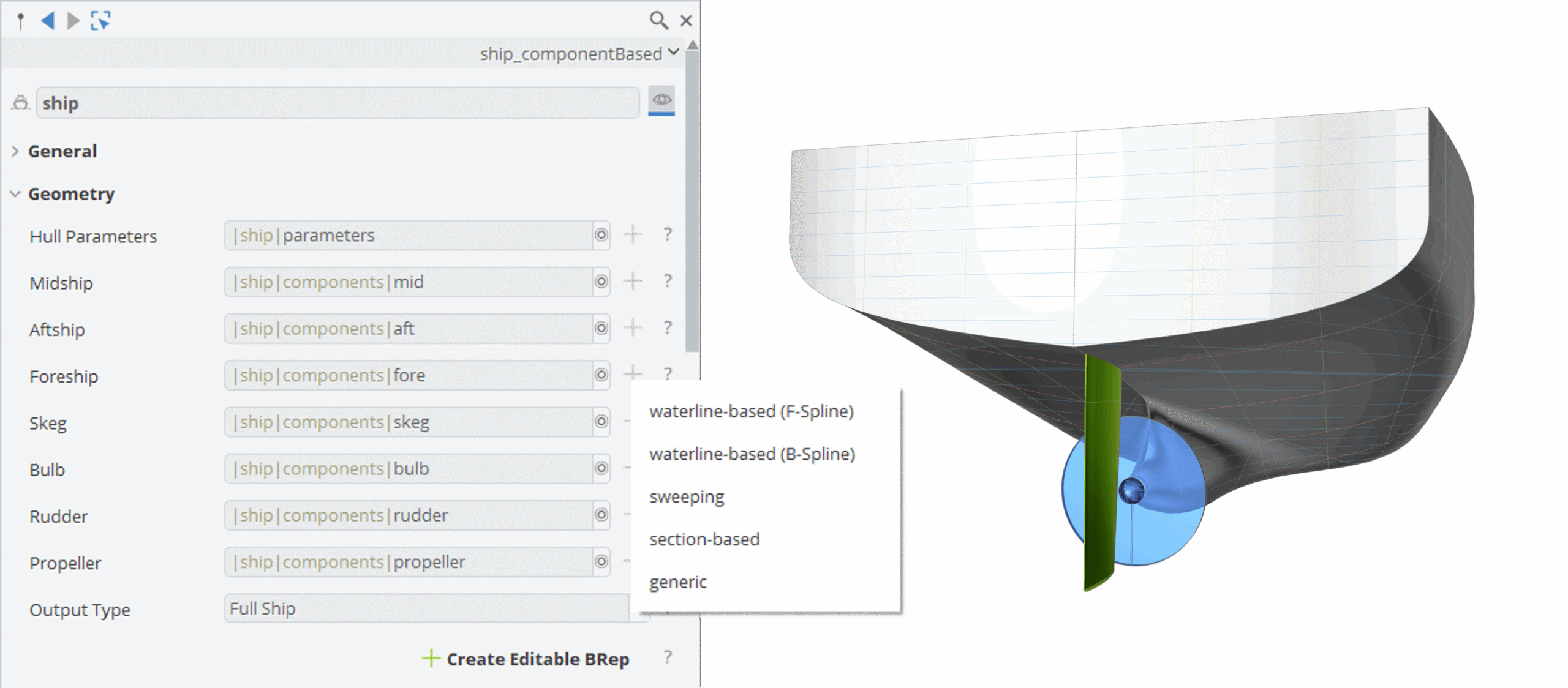
CAESES 5.4 continues to build on the component-based ship hull modeling workflow, further strengthening CAESES as a central tool for parametric ship design and optimization. The extended set of components allows users to create complex and realistic ship geometries in a modular, structured, and fully parametric manner.
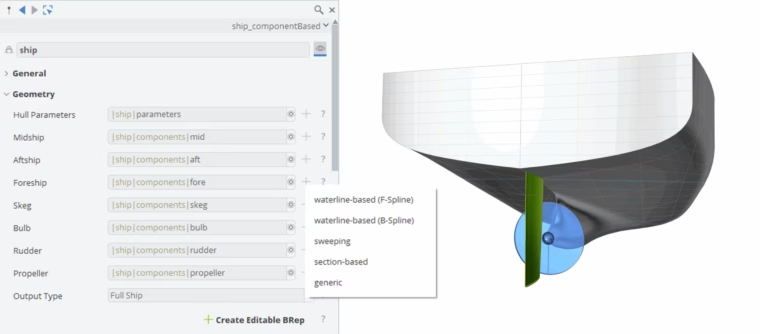
Newly added components for ship hull modeling include:
- Waterline-based aftship
- Section-based foreship
- Sweeping foreship
- A new F‑Spline version of the waterline-based foreship
- Center skeg for twin-screw vessel configurations
- Rudder components, including full-spade, balanced, and generic rudder types
- Propeller components, including actuator disc and generic propeller representations
These additions further empower naval architects to efficiently model a wide variety of ship types and configurations while maintaining full geometric control and variability. The component-based approach is particularly well suited for rapid model generation, as well as following design space exploration and optimization workflows, where consistency and robustness are essential.
Dedicated Workflow for Hard-Chined and Planning Boat Hulls
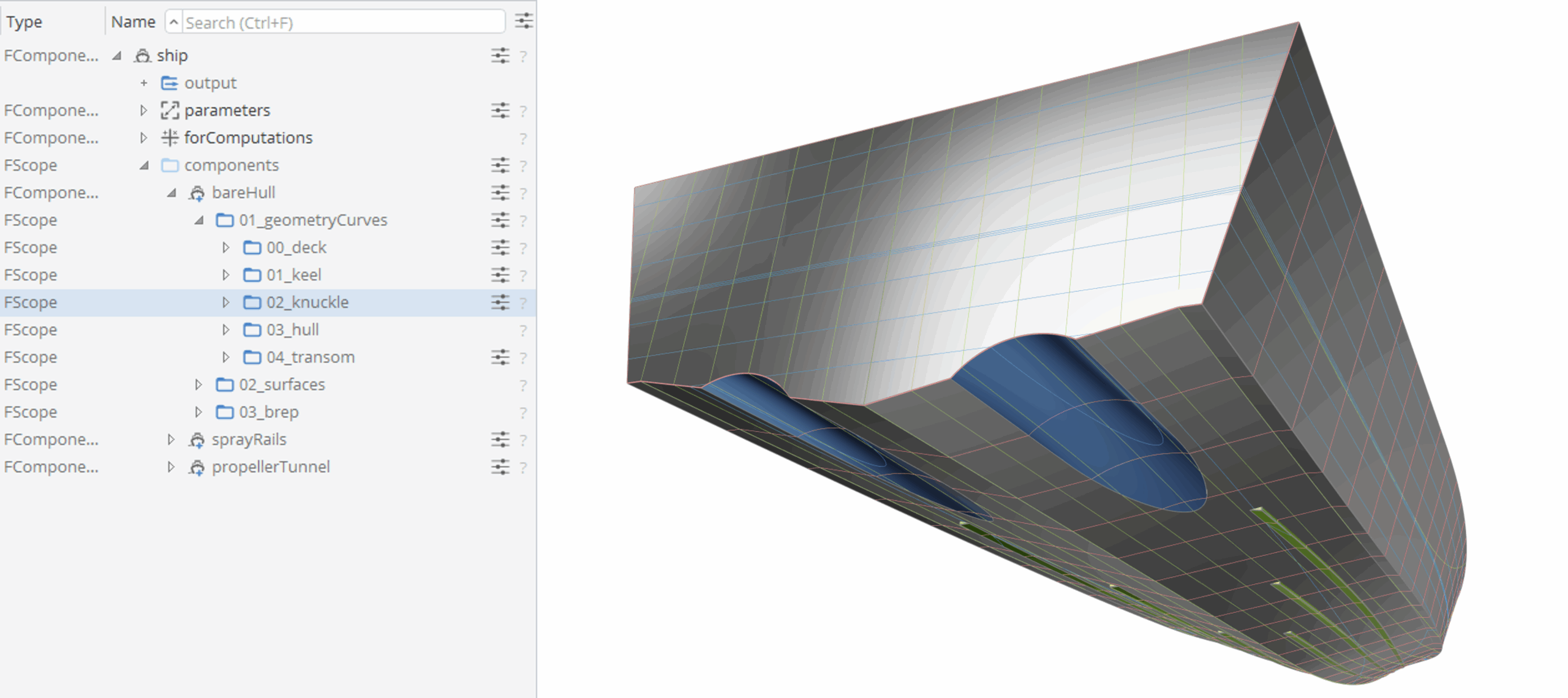
In addition to displacement vessels, CAESES 5.4 introduces a new dedicated workflow for hard-chined (planning) boat hulls. The workflow is based on a bare hull component and can be extended with optional functional elements, including:
- Spray rails
- Propeller tunnels
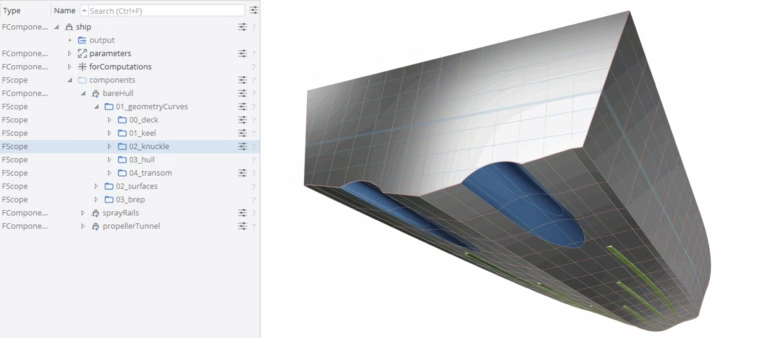
This new workflow provides a clean and efficient setup for modeling high-speed craft and planning boats, while fully preserving the parametric and associative nature of CAESES models. It allows designers to rapidly evaluate variations and assess performance-relevant geometric changes.
Enhanced Floating Conditions for Hydrostatic Computations
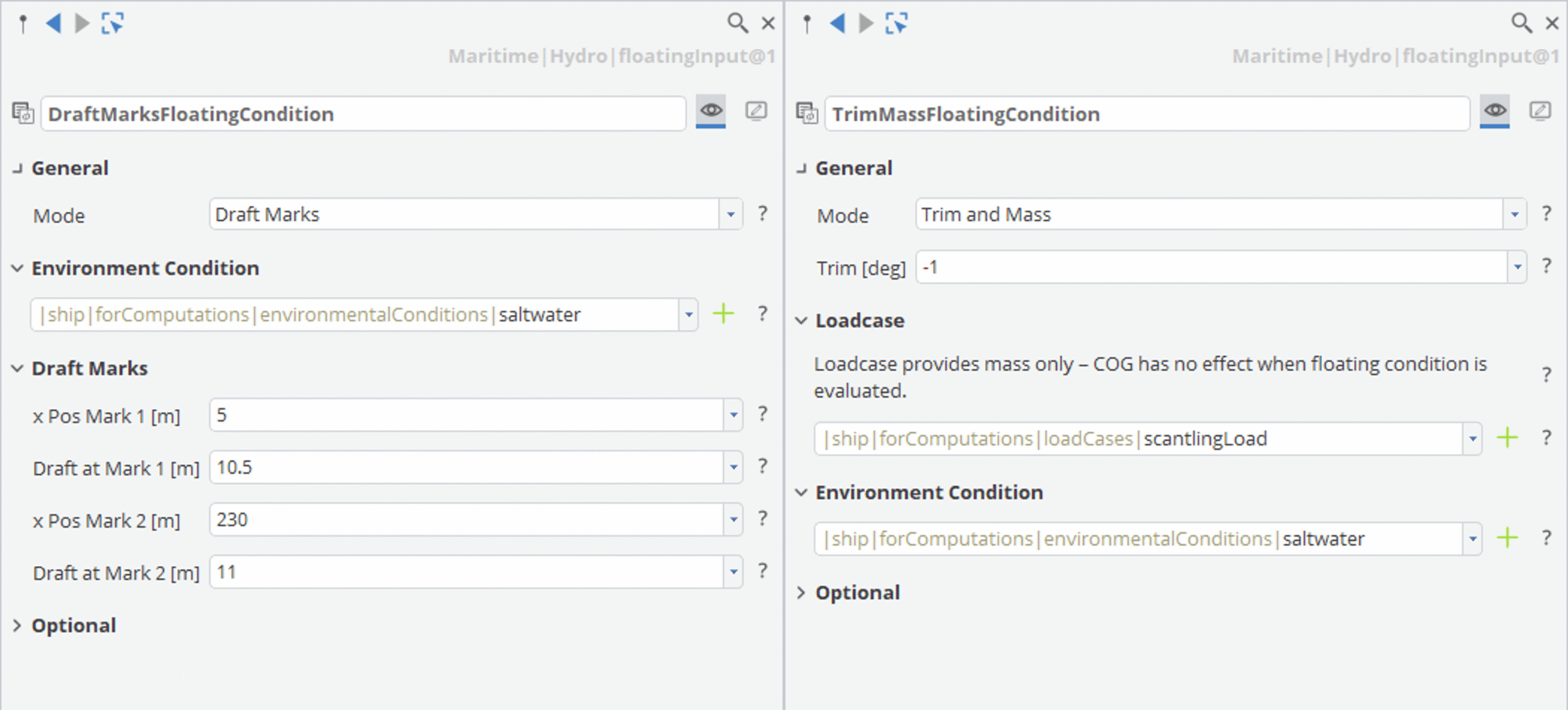
Hydrostatic analyses in CAESES 5.4 have been extended with additional options for defining floating conditions. Users can now specify floating conditions based on:
- A given trim angle and vessel mass
- Draft marks, defined by two longitudinal positions and the corresponding drafts at those locations
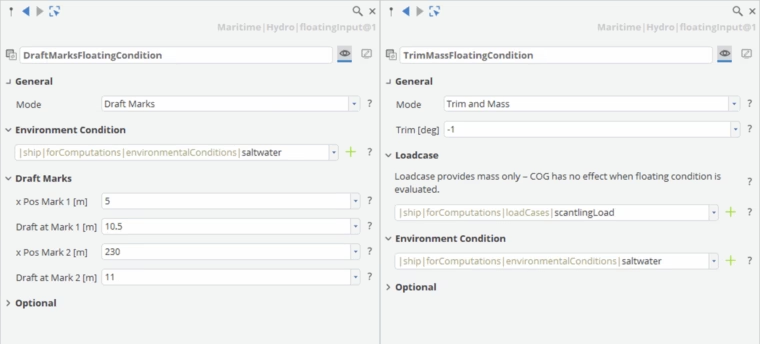
These new options provide greater flexibility when analyzing vessel behavior under different loading and trim scenarios, and better reflect real-world use cases commonly encountered in naval architecture projects.
Parametric Sample Models for Benchmark Vessels and Propellers
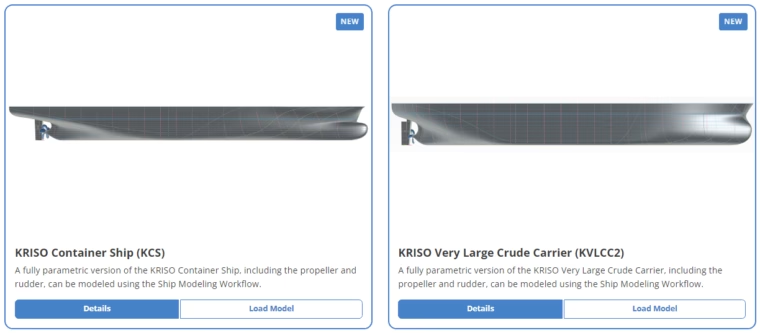
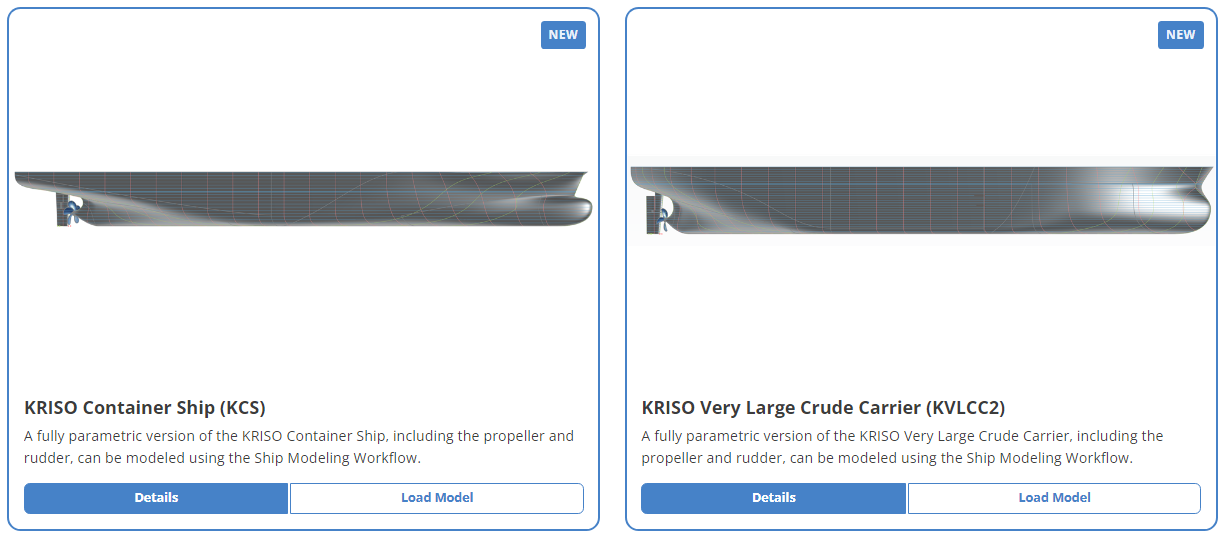
To support validation, simulation, and optimization studies, CAESES 5.4 includes fully parametric sample models of two widely used maritime benchmark vessels:
- KRISO Container Ship (KCS)
- KRISO Very Large Crude Carrier (KVLCC2)
Both models are implemented using the component-based ship hull workflow and yield simulation-ready geometries suitable for meshing and CFD analysis. At the same time, the models provide full geometric variability, making them ideal for optimization studies and method development.
In addition, new sample models are provided for a wide range of propeller types, including the well-known Potsdam Propeller Test Case (PPTC), further supporting propeller analysis and validation workflows.
Improved Geometry Export for Maritime Applications
CAESES 5.4 introduces a new option to export trimmed surfaces using IGES entity 144, as an alternative to exporting BReps or assemblies. This option is particularly helpful when transferring ship hull geometries to downstream tools such as NAPA, ensuring a smoother and more robust data exchange.
Advanced Curve Parameterization for Improved Surface Quality
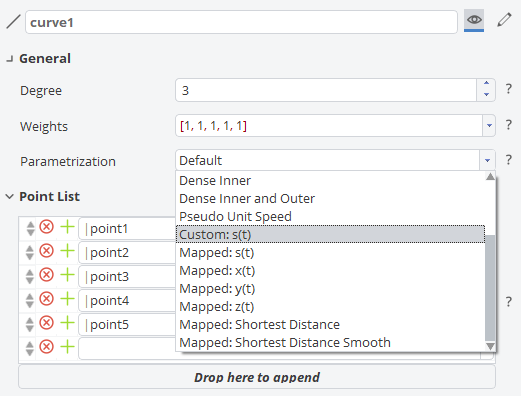
Several new curve parameterization options have been added in CAESES 5.4, giving users more flexible control over the speed of the curve parameter t∈[0,1] along a curve. These options make it possible to:
- Align the parameterization speed of multiple curves to a reference curve
- Achieve more consistent parameter distributions
- Create cleaner surfaces with better-ordered control polygons
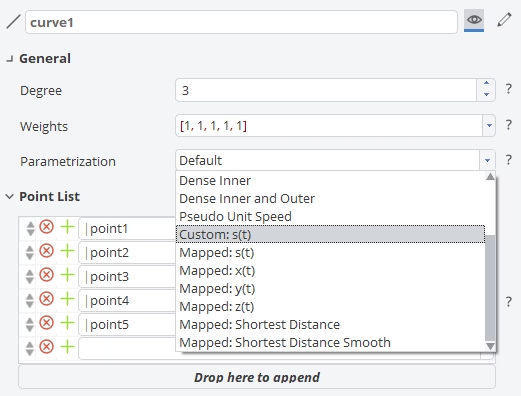
These enhancements are especially beneficial for high-quality surface modeling and for ensuring robust downstream operations such as meshing and optimization.
Introduction of the CTC Server (CAESES Task Controller)
A major new infrastructure feature in CAESES 5.4 is the introduction of the CTC Server (CAESES Task Controller). The CTC Server is a modular system designed to extend CAESES with advanced job scheduling and task management capabilities.


In its first release stage, CAESES 5.4 includes the Slurm Bridge module, which enables CAESES to interact directly with SLURM (Simple Linux Utility for Resource Management). Through this integration, CAESES can:
- Submit jobs to SLURM queues
- Monitor job states
- Cancel or reschedule running jobs
- Provide job monitoring via a lightweight web interface
This functionality is a key enabler for more scalable, automated, and HPC-oriented simulation workflows.
Numerous Additional Enhancements and Usability Improvements
Beyond the major features, CAESES 5.4 includes many smaller but impactful improvements across geometry modeling, usability, and visualization, such as:
- Custom labels for operations, making complex object trees easier to navigate
- Surface curvature visualization while interactively moving points
- Automatic slider creation in the object editor when design variables with bounds are defined
- A new BRep operation to color edges or edge sets based on a reference point
- A new option to create fillet surfaces with fixed tangent lengths
- A new NURBS surface command to propagate knots from a neighboring surface by raising the degree and inserting matching knots
- A new BRep command to check whether a given point is located inside a manifold BRep
Getting Started with CAESES 5.4
CAESES 5.4 is now available and ready to support advanced, simulation-driven design workflows – from maritime applications to general-purpose parametric geometry modeling.
For further details, please consult the CAESES documentation, the full change log, and explore the new sample models and workflows included with the release.