OSV design
Kongsberg Maritime uses CAESES for OSV design as a central hub, integrating hydrostatics, stability, seakeeping, DP, resistance, and cost in a multi-disciplinary workflow enabling automated optimization, improved operability, reduced CAPEX, and lower fuel consumption.

About Kongsberg Maritime
Kongsberg Maritime, a division of the Norwegian technology group KONGSBERG, has been designing ships for over 50 years, with more than 1,000 vessel designs delivered globally. Today, ship design at Kongsberg is strongly driven by sustainability: designs increasingly incorporate hybrid or alternative fuels (e.g. methanol, ammonia), energy-efficient hulls, reduced emissions technologies, and retrofits or conversion options to extend vessel life.
Safety and operational efficiency remain core design criteria, especially given that many of their vessels must endure demanding environments like offshore wind, polar waters and open seas.
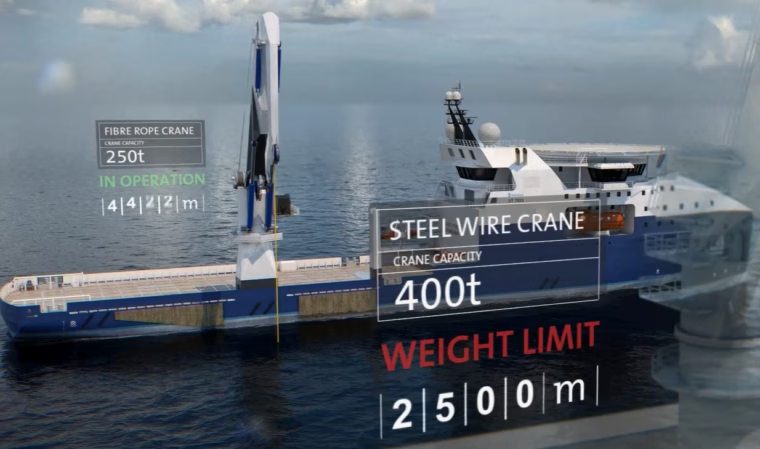
Offshore construction vessel with crane
Courtesy of Kongsberg Maritime
The challenge
Designing an advanced offshore service vessel (OSV) is inherently complex, especially when the mission requirements involve subsea installation in deep waters using an active heave-compensated crane. Such vessels must maintain excellent stability during heavy lifts, offer reliable station-keeping in harsh conditions, and remain energy-efficient across varied operational modes. Early design decisions – such as main dimensions, hull geometry, weight distribution, and thruster layout – have far-reaching consequences for CAPEX, fuel consumption, and operational performance.
However, these parameters are highly interdependent: improving stability may affect resistance; optimizing the hull form influences windage and DP demands; and crane configuration impacts vertical center of gravity and thus feasible vessel dimensions. Typical sequential design cannot fully capture these interactions. The task therefore requires a holistic, tightly integrated workflow capable of linking hydrostatics, stability, seakeeping, DP performance, power demand, and cost modelling within a single assessment loop. This creates a clear need for a flexible platform that can handle robust geometry variation while coordinating multiple external simulation tools efficiently.
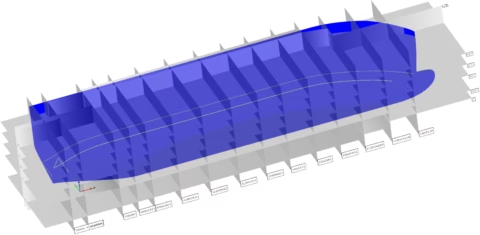
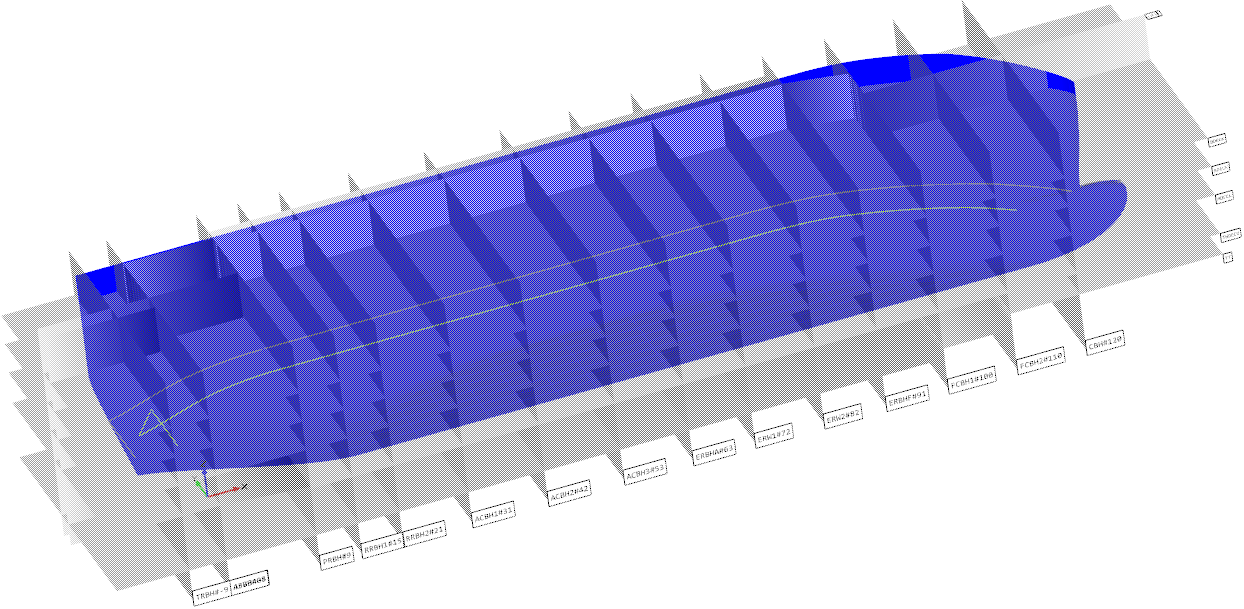
Ship hull with definition of internal subdivisions
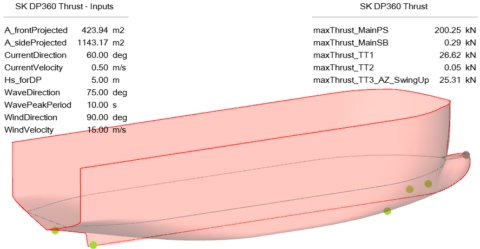
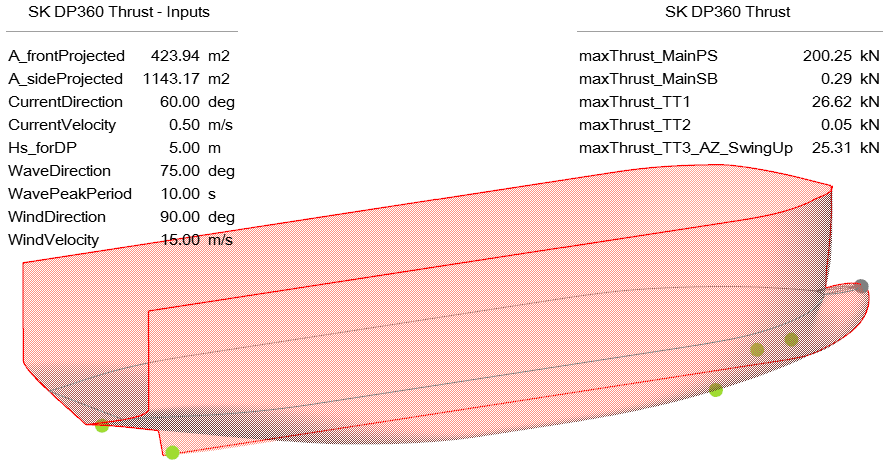
Thrust determination for propulsors in DP operation
The solution
Kongsberg Maritime built on CAESES as the central hub for the OSV's preliminary design phase. CAESES provides a powerful parametric geometry model of the OSV hull that can be modified reliably across a large design space – adjusting length, breadth, draught, hull curvature, and sectional shapes. This ensures all design variants remain watertight, stable, and suitable for downstream simulations.
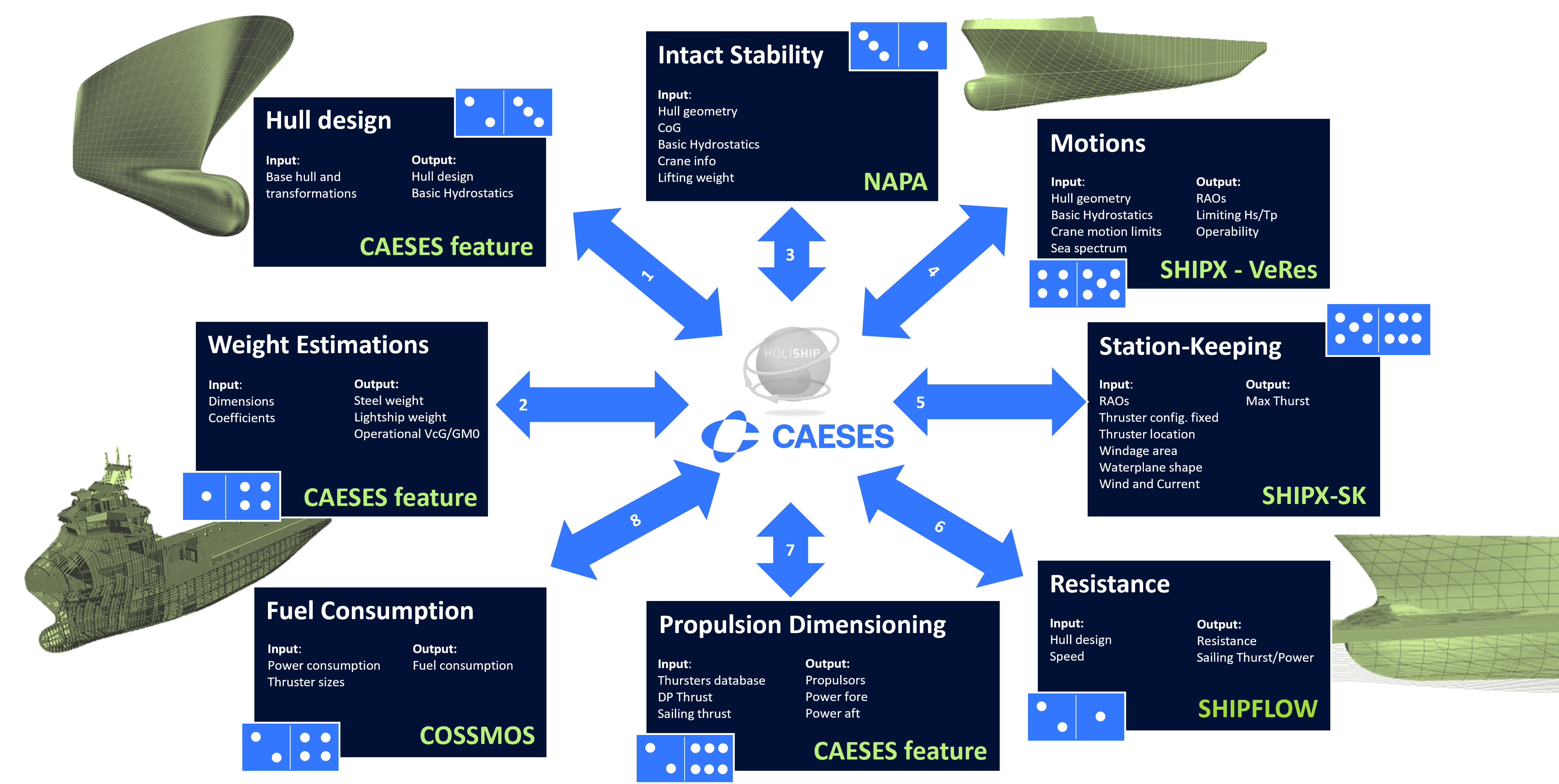
CAESES is also used to orchestrate an extensive multi-disciplinary workflow. Hydrostatics, loading conditions, and intact stability checks are performed directly within the platform. External tools – such as ShipX VERES for motion analysis, ShipX Station Keeping for DP evaluations, NAPA for stability verification under crane loads, SHIPFLOW for wave resistance, and COSSMOS for power and fuel assessments – are all linked through automated CAESES features. Data flows seamlessly between steps, with CAESES managing dependencies, constraints, and KPIs.
This integration enables automated multi-objective optimization, balancing parameters such as GM, DP thrust requirement, operability limits, resistance, and cost. Surrogate models are created inside CAESES to accelerate resistance predictions, making it possible to explore hundreds of feasible design variants quickly. By synchronizing all disciplines around a single, consistent hull definition, CAESES functions as the holistic design engine of the project, providing a smooth transition from concept exploration to more detailed system evaluations.
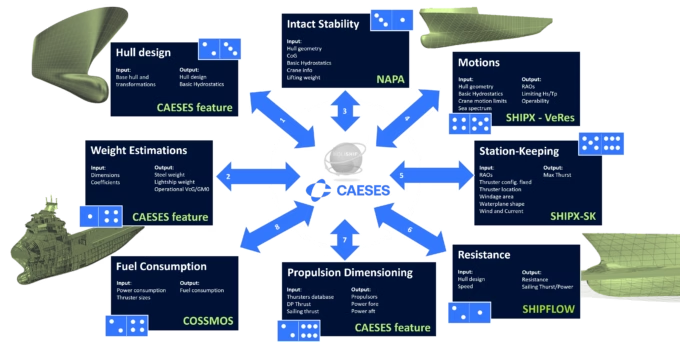
Holistic preliminary design process for OSVs with coupled disciplines and tools
The benefits
Using CAESES allows the team to investigate the full design space with confidence, ensuring only feasible and well-balanced hull variants are evaluated. The ability to run complex multi-disciplinary analyses automatically reduces manual workload and eliminates inconsistencies that typically arise when geometry and simulations are handled separately.
For the offshore construction vessel, this integrated process led to the identification of a compact and well-balanced vessel design – optimally tailored to the mission profile. The resulting concept delivered notable performance and cost improvements, including a reduction of roughly 5% in CAPEX through decreased lightship weight and more appropriately sized propulsion units. Fuel consumption over the operational profile was cut by about 6%, supporting both lower OPEX and reduced environmental impact. The coordinated stability and seakeeping evaluations also enhanced confidence in operability and DP performance during heavy-lift operations.
Beyond the specific vessel design, the project established a fully repeatable, scalable workflow that could be applied to future OSV designs. By allowing designers to evaluate geometry, hydrodynamics, power demand and cost in a single environment, CAESES significantly accelerates early-stage decision-making and helps the team converge on higher-quality solutions with less risk.
More case studies
Naval ship design
TKMS leverages CAESES for naval vessel hydrodynamic design, enabling rapid hull form exploration through parametric modelling and CFD integration, balancing speed, stability, and efficiency while optimizing appendages and aftbody geometry under tight proposal-stage constraints.
Turbocharger impeller design
Using CAESES, mtu Solutions implemented a fully automated, multi-objective optimization workflow for turbocharger design, integrating aerodynamics, structural, thermal, and mass analyses to deliver near-production solutions with over 50% reduced development time and engineering efficiency gains.