Naval ship design
TKMS leverages CAESES for naval vessel hydrodynamic design, enabling rapid hull form exploration through parametric modelling and CFD integration, balancing speed, stability, and efficiency while optimizing appendages and aftbody geometry under tight proposal-stage constraints.
“Using the workflow we have built with CAESES, we can offer optimized hull shapes operating with minimum engine power at maximum speeds within a short time frame.”
Tanja Richardt
Project Engineer

About TKMS
TKMS (formerly Thyssenkrupp Marine Systems) is one of the world’s leading naval shipbuilders, specializing in the design and construction of submarines, surface vessels, and naval systems.
Based in Germany, TKMS is renowned for its advanced engineering, innovation in non-nuclear submarines – such as the Type 212A and Type 214 – and its commitment to high-quality, reliable maritime defense solutions. With decades of experience and a global customer base, TKMS plays a crucial role in strengthening naval capabilities worldwide.
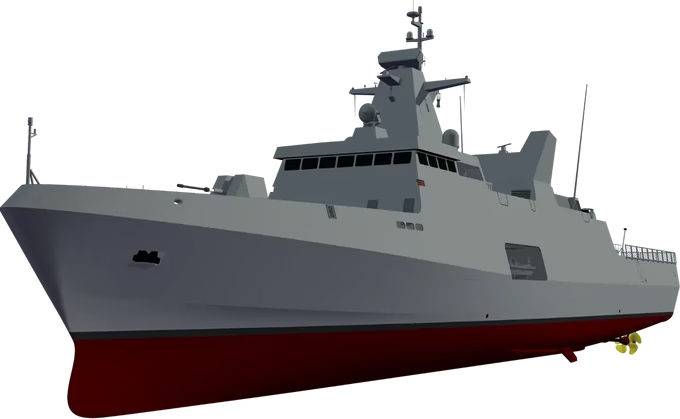
MEKO® A-100 patrol corvette
Courtesy of TKMS
The challenge
During the proposal stage of a naval vessel, hydrodynamic design faces a range of complex challenges driven by tight timeframes, incomplete data, and demanding performance goals. Designers must explore a wide range of hull form variations quickly, often without a fully finalized mission profile or mature specifications. This requires balancing conflicting requirements such as speed, stability, fuel efficiency, and payload capacity across various operational conditions such as patrol, pursuit, or loitering. Additionally, constraints on engine power and cost must be factored into achieving maximum speed and economic performance.
Aftbody geometry, appendages, and the impact of trim-control devices like interceptors further complicate early predictions, as their effects on resistance and floating position are highly sensitive. Without the ability to perform physical model testing at this stage, teams rely on CFD and simulation tools, which must deliver reliable results despite limited computational resources. All of this must be achieved while minimizing technical risk and ensuring that early design decisions can be defended later in the project. Ultimately, the challenge lies in delivering optimized, validated hull forms within a short timeframe – forms that meet performance goals while remaining feasible and cost-effective.
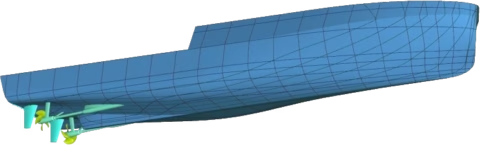
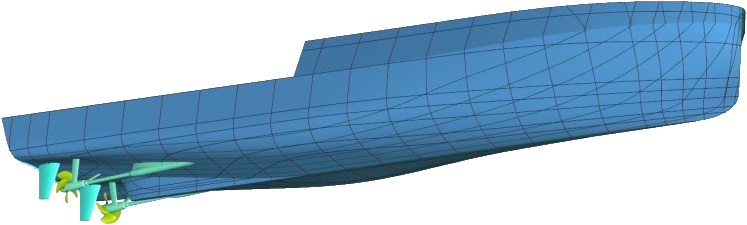
Parametric model of fully appended ship
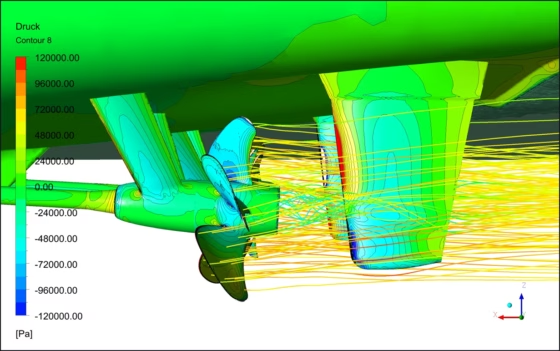
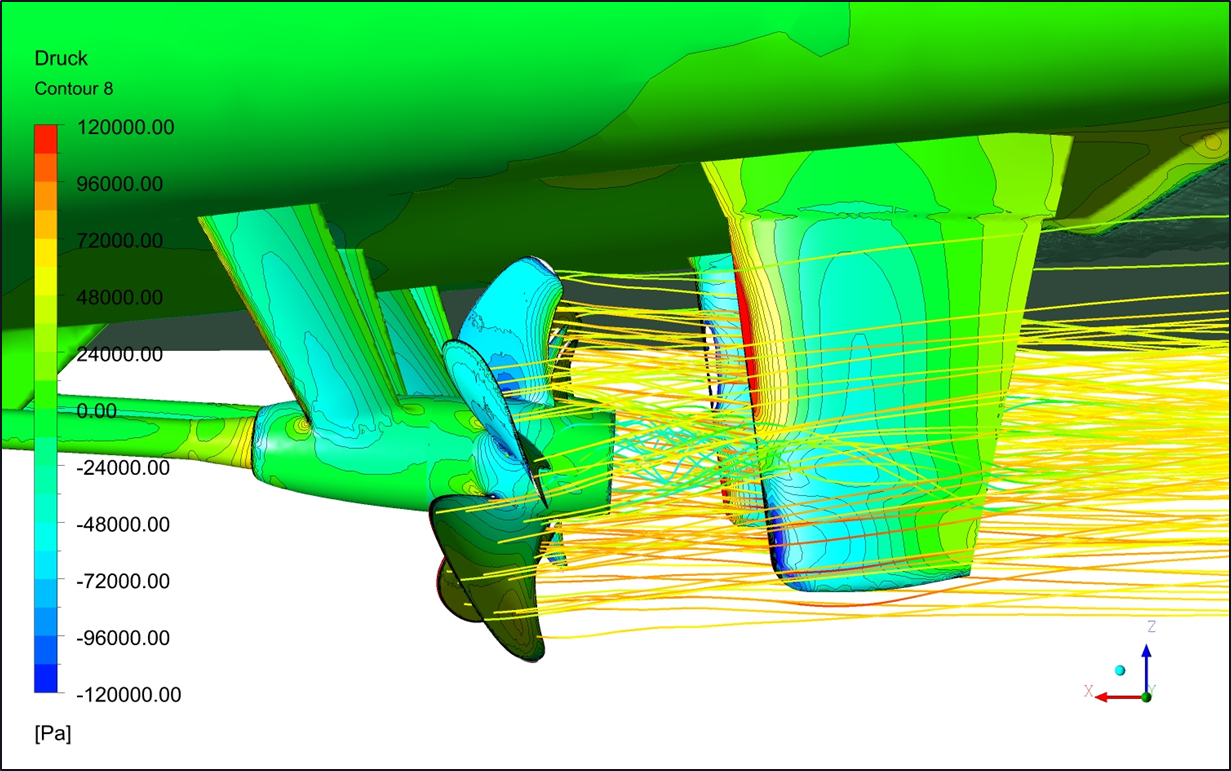
RANS simulation of propeller and appendage flow
The solution
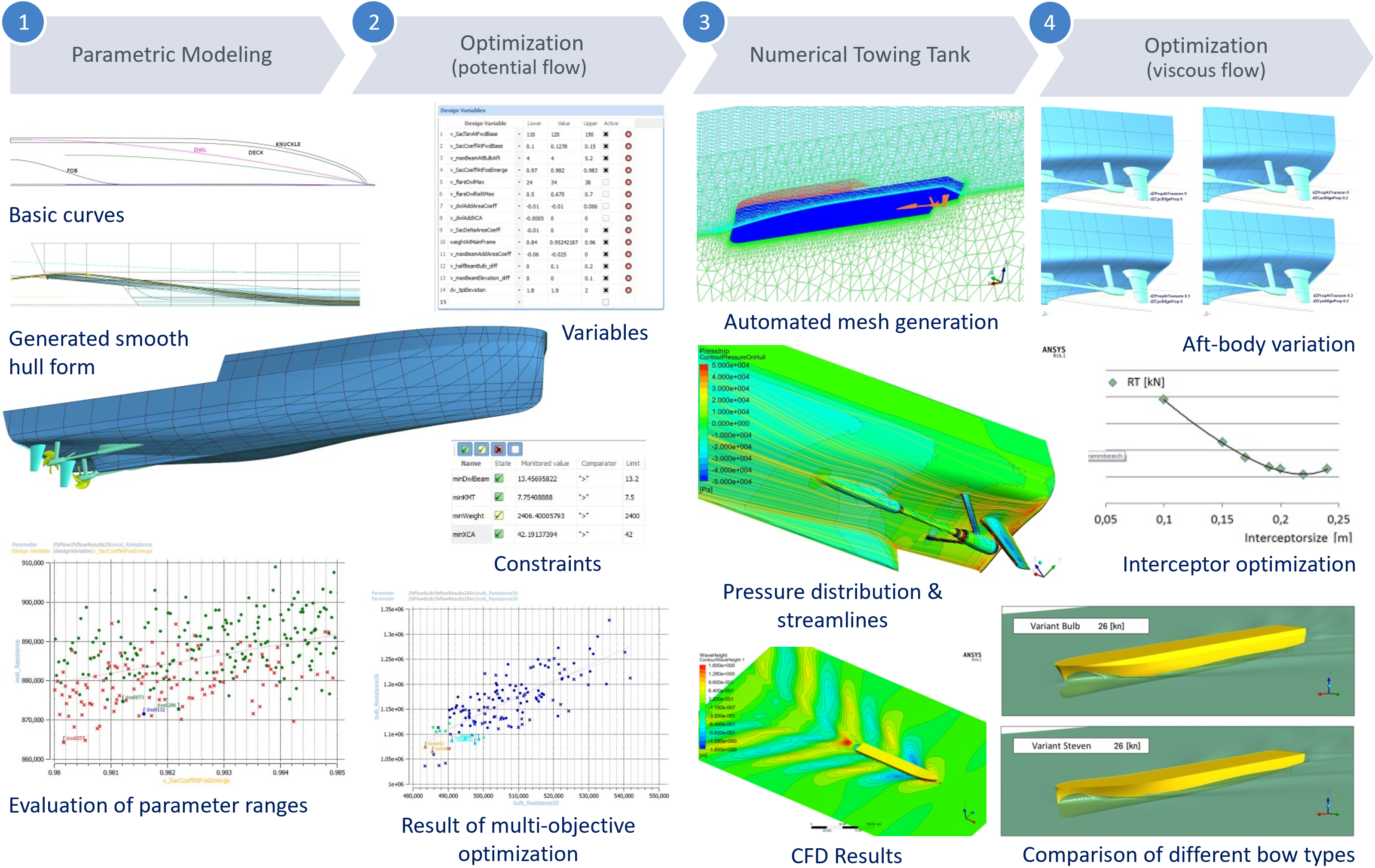
Leveraging the capabilities of CAESES as a data- and simulation-driven design platform, TKMS established an efficient, multi-stage process for hydrodynamic design that integrates both potential and viscous flow analysis tools. In the initial phase, a fully parametric model of the vessel is created, including all relevant appendages. This model is built using CAESES' meta-surface technology, which enables the precise definition of complex free-form surfaces through key longitudinal curves such as the design waterline, centerplane curve, deck contour, sectional area curve, and the section tangents distribution at the waterline. The modular structure of the model allows for flexible combinations of different forebody and aftbody configurations.
This parametric foundation enables systematic generation of geometry variants, which can be directly exported to simulation tools for fully automated performance analysis. Design constraints – such as displacement, center of buoyancy, upright stability, and internal arrangement limits – are defined to guide the process. The first optimization phase focuses on minimizing wave-making resistance at various speeds using a potential flow solver. Promising variants from this stage are then evaluated with higher-fidelity viscous flow (RANS) simulations with ANSYS CFX to obtain accurate performance metrics and to analyze detailed flow behavior, especially around appendages. A final optimization step targets the aftbody geometry and interceptor sizing, addressing aspects not adequately captured by potential flow methods.
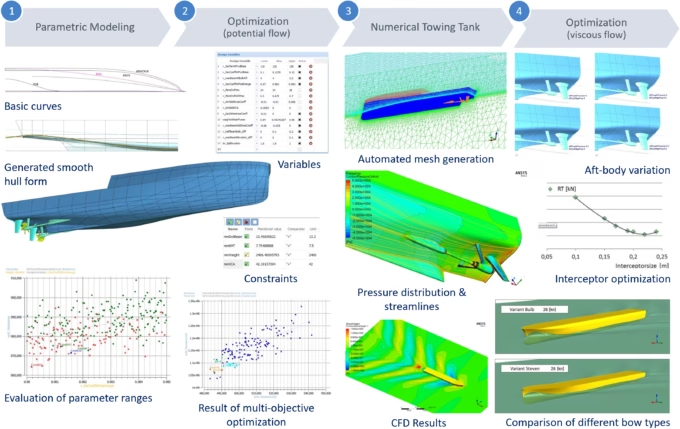
Multi-stage integrated workflow for the hydrodynamic design of the appended ship hull
The benefits
Using this workflow provides TKMS with significant benefits during the proposal stage of naval vessel design. It enables rapid exploration of a wide range of hull form variants within a short time frame, allowing designers to efficiently respond to changing requirements. Hull shapes can be optimized for different speeds and load conditions while meeting demanding performance and mission criteria.
The workflow supports the achievement of maximum speed with minimal engine power, taking into account cost limitations and realistic operational profiles. It also integrates the effects of aftbody variations, appendages, and interceptor-induced trim changes to improve prediction accuracy. By providing reliable performance estimates early in the design process through automated simulations and parametric modeling, CAESES helps reduce technical risk and supports confident decision-making.
Overall, it empowers design teams to deliver high-quality, hydrodynamically optimized solutions quickly and with greater precision.
More case studies
OSV design
Kongsberg Maritime uses CAESES for OSV design as a central hub, integrating hydrostatics, stability, seakeeping, DP, resistance, and cost in a multi-disciplinary workflow enabling automated optimization, improved operability, reduced CAPEX, and lower fuel consumption.
Turbocharger impeller design
Using CAESES, mtu Solutions implemented a fully automated, multi-objective optimization workflow for turbocharger design, integrating aerodynamics, structural, thermal, and mass analyses to deliver near-production solutions with over 50% reduced development time and engineering efficiency gains.