Presentation at FAST 2025
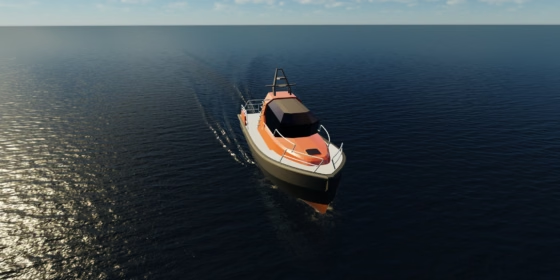
At the 2025 SNAME FAST, FRIENDSHIP SYSTEMS and HydroComp, Inc. will present a collaborative study that replicates the design path of the AutoPlan R&D project — an 11 m planing monohull designed for 27.5 knots — to compare outcomes and resource requirements between Fully Computational CFD-based Design Space Exploration (FC-DSE) and Semi-Empirical Reduced-Order Design Space Exploration (SERO-DSE) approaches.
Using CAESES for parametric hull modeling and automated connection to NavCad, the workflow enables efficient exploration of hull form variants. NavCad provides detailed predictions for resistance figures, engine power, and efficiency data — allowing performance evaluation of each design variant quickly and accurately within the optimization loop.
Key findings:
- FC-DSE (CFD): 11.6 % reduction in shaft power at model scale
- SERO-DSE (NavCad): 14.9 % reduction in shaft power at full scale
- Nearly identical optimized hull geometries — achieved in a fraction of the time, from hours to seconds
Semi-empirical, reduced-order simulation proves to be a powerful framework for early-stage marine design. While not a replacement for CFD, it serves as a highly effective front-end filter, enabling designers to rapidly identify the most promising concepts for high-fidelity analysis.
This approach lowers the barrier to robust DSE, promotes earlier, data-informed decision-making, and supports the broader adoption of energy-efficient, next-generation vessel designs.
Join the presentation and come see us at our booth at the 2025 SNAME Maritime Convention!