Polymer Injection Molding: Shape Optimization with CFD
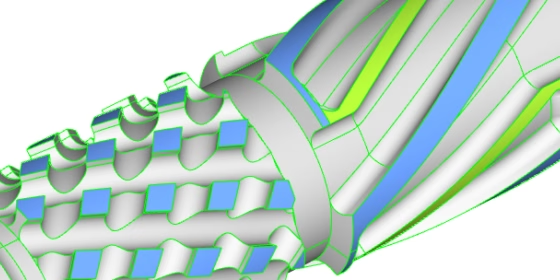
Klaus Straka is one of our absolutely amazing CAESES® users, who is active in the field of polymer injection molding. In the context of fully-automated shape optimization with CFD (fluid flow simulation), he creates incredible parametric geometries with CAESES® that are pretty complex and highly challenging. We are happy to share a few insights with you through an interview with Klaus.

“By using CAESES we are able to automate our design and process simulation chain with the benefit of a faster and less error prone process setup.”
Klaus Straka
Institute of Polymer Injection Molding and Process Automation of the Johannes Kepler University in Linz, Austria (JKU)
Polymer Injection Molding: Geometry Modeling, Simulation and Optimization
Interview with Klaus Straka, JKU Linz
FS: Hi Klaus! Can you first describe the industry and the applications you are involved in?
Klaus: At the Institute of Polymer Injection Moulding and Process Automation (ipim) of the Johannes Kepler University in Linz / Austria (JKU) we are working on process simulation and optimization in the field of polymer processing, and more specific, polymer injection molding. The applications cover polymer felt flow simulations in screw plasticizing units with respect to mixing efficiency, the simulation of the injection molding process and thermal simulations of the injection molding modules.
FS: How did you get into this specific field of engineering?
Klaus: After I finished the study of mechatronics at the JKU I worked a few years in industry as a control system engineer for injection molding machines. When the ipim was founded in 2009 I returned to the JKU and started to investigate mixing behavior in plasticizing screws on experiments and simulations.
FS: What is your personal field of expertise?
Klaus: My field of expertise lies in computational methods for fluid dynamics with respect to polymer melt flow and measurement system engineering. The latter is important to judge the correctness of the results of CFD simulation results.
FS: What project do you work on at the moment?
Klaus: I am still working on the simulation of thermal and optical polymer melt homogeneity in screw plasticizing units and there is plenty of work to do.
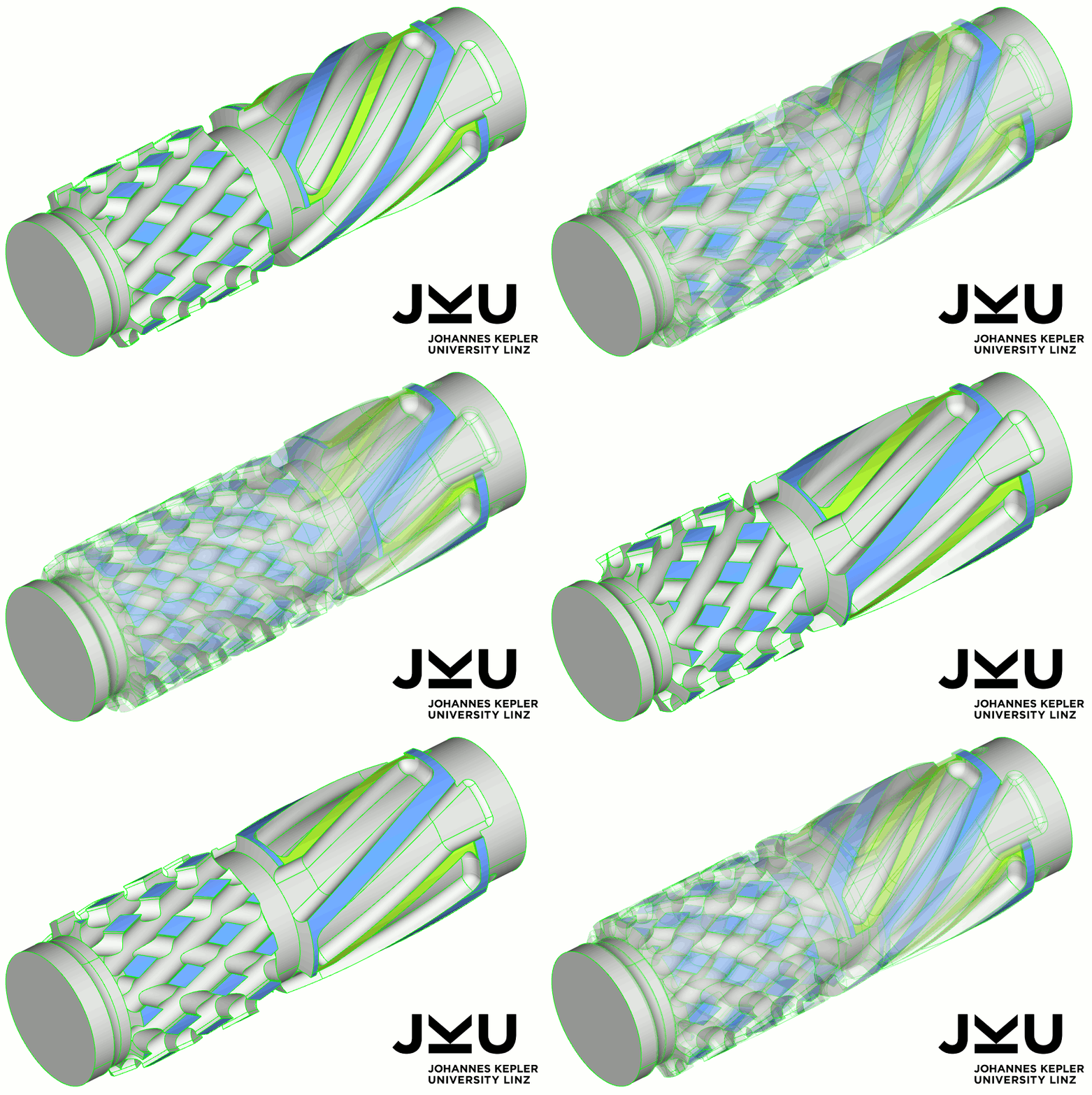
Variable CAESES geometry model of the shear head for polymer injection molding
FS: What are the most challenging parts of this project?
Klaus: In the past the most challenging parts have been the extension of the numerical methods and the implementation of a high-order particle tracking method in the used CFD software. Now, the parametric description of the complex geometries as well as the generation of a suitable numerical grid is somewhat time consuming. And finally the interaction of several software tools makes the design studies error-prone.
FS: Which software solutions do you use for your engineering tasks?
Klaus: For the CFD part we use the open source package OpenFOAM which we extended to correctly model the flow of polymer melts. For post processing of simulation and measurements we typically use MATLAB as it is fast and comparatively easy to use. In the past the description of the screw geometries and flow domains was done with PTC Creo, which is now done by CAESES.
FS: How does CAESES further support you in your work?
Klaus: CAESES simplifies and reduces errors in the engineering work as it is possible to highly automate the workflow. First and foremost, CAESES is quite powerful in the parametric description of my target geometries. Next, it is quite easy to automatically adapt input files for OpenFOAM, the so-called dictionaries, prior to the simulation. The same is true for my MATLAB post processing scripts. And once the process is set up correctly for a base geometry, you can perform design studies with nearly no effort.
FS: What do you like about CAESES, what do you think makes it unique?
Klaus: What I like best is the smooth interaction of CAESES with OpenFOAM and MATLAB and the above described ability to automate the engineering process. In my case, this is varying geometry parameter of a screw head, start a simulation in OpenFOAM, do the post processing in MATLAB and analyze the results in a single software environment.
FS: What are your time frame and the rough schedule for your current work?
Klaus: By now, the geometry setup and performing design studies for screw mixing heads runs reasonably well and stable. In the near future it is planned to take a closer look on the optimization capabilities of CAESES. I am confident that this feature will reduce the amount of simulation time necessary to improve the mixing ability of plasticizing screw heads.
FS: Klaus, thanks a lot for sharing this interesting insights and for allowing us to publish these impressive geometries!
Follow Us
If you are interested in CAESES and in CFD-driven design optimization, then sign up for our newsletter. Don’t worry, we won’t bother you with too many emails. Of course, you can unsubscribe at any time :-)