From pencil to generative AI: the evolution of engineering design
Traditional Drafting
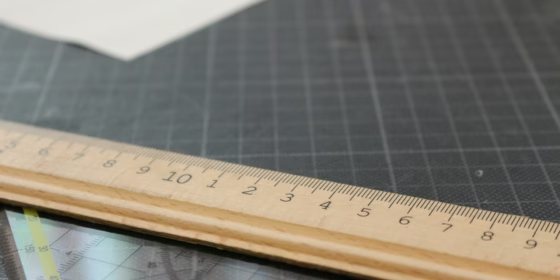
For centuries, engineers began every concept with a sketch. A few lines on paper were enough to structure ideas, estimate proportions, and visualize an outcome before anything was built. Before computers, designs were drawn by hand using traditional instruments such as rulers, compasses, and protractors. Yet freeform shapes, such as a ship’s bow, could not be captured precisely with these rigid tools.
To draw smooth curves at full scale, engineers used flexible wooden strips known as splines, held in place by lead weights called ducks. Between these anchor points, the spline naturally formed the smoothest possible curve, achieving both precision and elegance. The drawing board served not just as a workspace but as a physical extension of an engineer’s thought process.

Computer-Aided Design (CAD) Modeling
As computers entered the design process, engineers began to study the physical properties of splines so they could be modeled with mathematical precision and reproduced digitally whenever needed. The iterative definition of basis functions in NURBS (Non-Uniform Rational B‑Splines) aligned perfectly with the increasing computational power of early computer systems, enabling levels of computational calculation, precision, and B‑Rep (Boundary Representation) modeling far beyond human capability. The transition from mainframe computers to minicomputers and eventually to personal computers in the 1980s made computer-aided design (CAD) accessible to a much wider audience. The mouse replaced the pencil, becoming a new extension of the human mind. It offered enhanced precision, digital standards, and file formats that streamlined workflows and reduced manual errors.
While CAD revolutionized efficiency, it did not fundamentally change the underlying approach of design. Similar to traditional drafting, CAD still relied on the designer’s judgment to ensure overall consistency by placing geometric primitives or digital annotations within a virtual drawing space. The concept of layers in CAD reflected the additive logic of the traditional drawing board, now translated into the digital realm.

Parametric Modeling and Algorithmic-Aided Design (AAD)
In the 1990s, major advancements in 3D modeling and parametric design introduced feature-based solid modeling. These developments significantly changed how designers and engineers approached geometry, giving rise to modern parametric and algorithmic-aided design (AAD).
Algorithms began to generate geometries directly. When an integrated editor was used within CAD or other modeling software, objects were no longer manipulated by hand or with a mouse. Instead, they were defined through procedures expressed in programming languages.
This approach, known as scripting, was relatively new to design practice. It redefined the connection between the designer’s idea and the final output. The result was no longer a static digital drawing but an interactive digital model that could respond dynamically to changes in input, manipulating the entire system accordingly.
The combination of human judgment, computer programming, and engineering methods expanded creative and analytical capabilities beyond what could be achieved manually.

Simulation-Driven Design (SDD) with CAESES
CAESES®, introduced in 2001, provides a specialized CAD environment for parametric modeling and integration with simulation tools. It includes its own scripting language, the Feature Programming Language (FPL), which allows users to automate modeling tasks, create custom features, and link external tools directly to the design process.
Anything that can be executed in batch mode can be connected to CAESES, making it particularly effective for coupling with CFD codes and other simulation software. It also offers a complete optimization framework for exploring and refining the design space through Design of Experiments (DoE) and advanced optimization algorithms.
This process defines simulation-driven design (SDD), where simulations guide engineers toward optimal solutions based on data and performance rather than intuition. For the past 25 years, simulation-driven design has led the way in advancing modern engineering.

Future with Data-Driven Engineering (DDE)
The future is increasingly shaped by the rise of generative AI. Artificial intelligence has long been familiar to engineers through methods such as linear regression, machine learning, and surrogate modeling, but in recent years, the rapid growth of generative AI and large language models (LLMs) has shown that AI-based systems and intelligent agents are becoming an essential part of engineering.
The focus is gradually shifting from simulation-driven design (SDD) toward data-driven engineering (DDE). Engineers today often possess extensive simulation data that requires significant computational time to produce. It is not efficient to rerun new simulations for every design variation, especially when these computations can take hours or even days and require access to high-performance computing systems or large clusters.
When data is already available, the goal is to develop a machine learning-based surrogate model that can instantly retrieve results, even on a standard laptop. When data is limited, engineers can use Design of Experiments (DoE) algorithms, such as a Sobol sequence, to explore the design space efficiently, performing as few simulations as possible to build accurate surrogate models. These models then enable quick predictions and design evaluations without the need for repeated costly simulations.
This approach also enhances collaboration among colleagues. Once the setup is complete, users do not need to be CFD experts to explore design alternatives. With a well-prepared parametric model, they can adjust parameters and immediately observe how performance metrics change.
However, one must always consider the limits of extrapolation. The accuracy of machine learning and surrogate models depends on the quality of the data, the coverage of the design space, and the nature of the underlying physical problem.
Therefore, a human expert remains essential to evaluate and validate the outcomes, and across all stages of design and manufacturing, the process remains human-centric. The engineer continues to think, decide, and create, while the medium evolves to meet new challenges. Each new generation of tools, from pencil to code to generative AI, expands the creative and analytical power of the human mind, enabling design with greater intelligence, creativity, and understanding.