Simulation- and data-driven propeller design
Explore and optimize propeller geometries through parametric geometry variation, automated simulation workflows, and multidisciplinary design studies.
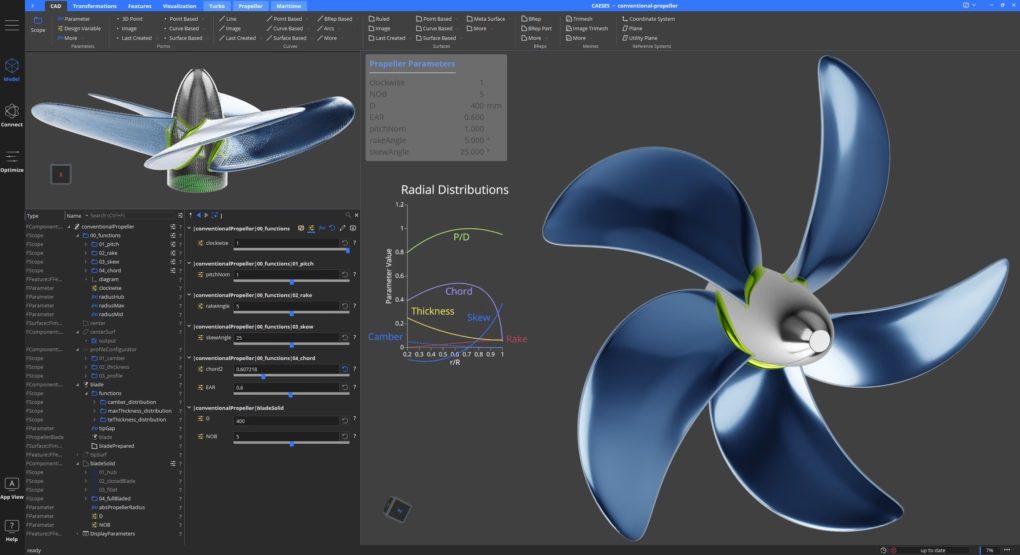
Why choose a simulation- and data-driven design approach?
Optimized performance across operating conditions
Simulation-driven propeller design allows engineers to evaluate how different geometries perform under varying speeds, loads, and environmental conditions. This helps identify designs that maximize efficiency and propulsion performance in real-world operation.
Reduced development time and costs
Virtual testing enables rapid assessment of numerous blade shapes and configurations without the need to manufacture and test each concept physically. As a result, development cycles are shortened and prototyping costs are significantly reduced.
Enhanced reliability and reduced risk
A data-driven engineering approach combines simulations, as well as data from other sources to better predict issues such as cavitation, vibration, and noise. This leads to more robust propeller designs with improved durability and lower operational risk.
CAESES’ propeller design capabilities
CAESES is a specialized CAD and automation tool for optimizing complex, performance-critical geometries, with some dedicated capabilities that make it particularly suited for the design of cutting-edge propellers.
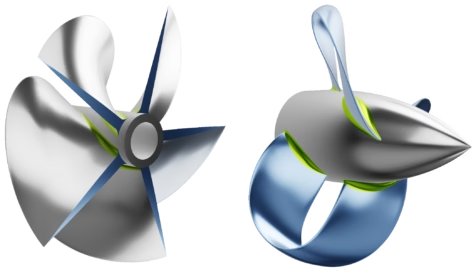
Smart parametric modeling
Fully parametric modeling of any type of marine propeller, including unconventional types such as surface-piercing, high-skew, tip-rake, ducted, toroidal, and low-noise submarine propellers.
Smart parametric modeling approach based on parameterized sections and continuous control of the respective input parameters.
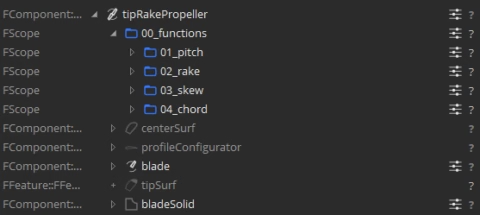
Intuitive yet customizable
Dedicated modeling workflows for propellers greatly simplify the process.
Yet, high level of customization, i.e., no black box models and full freedom to set up user-defined parameterizations and workflows.
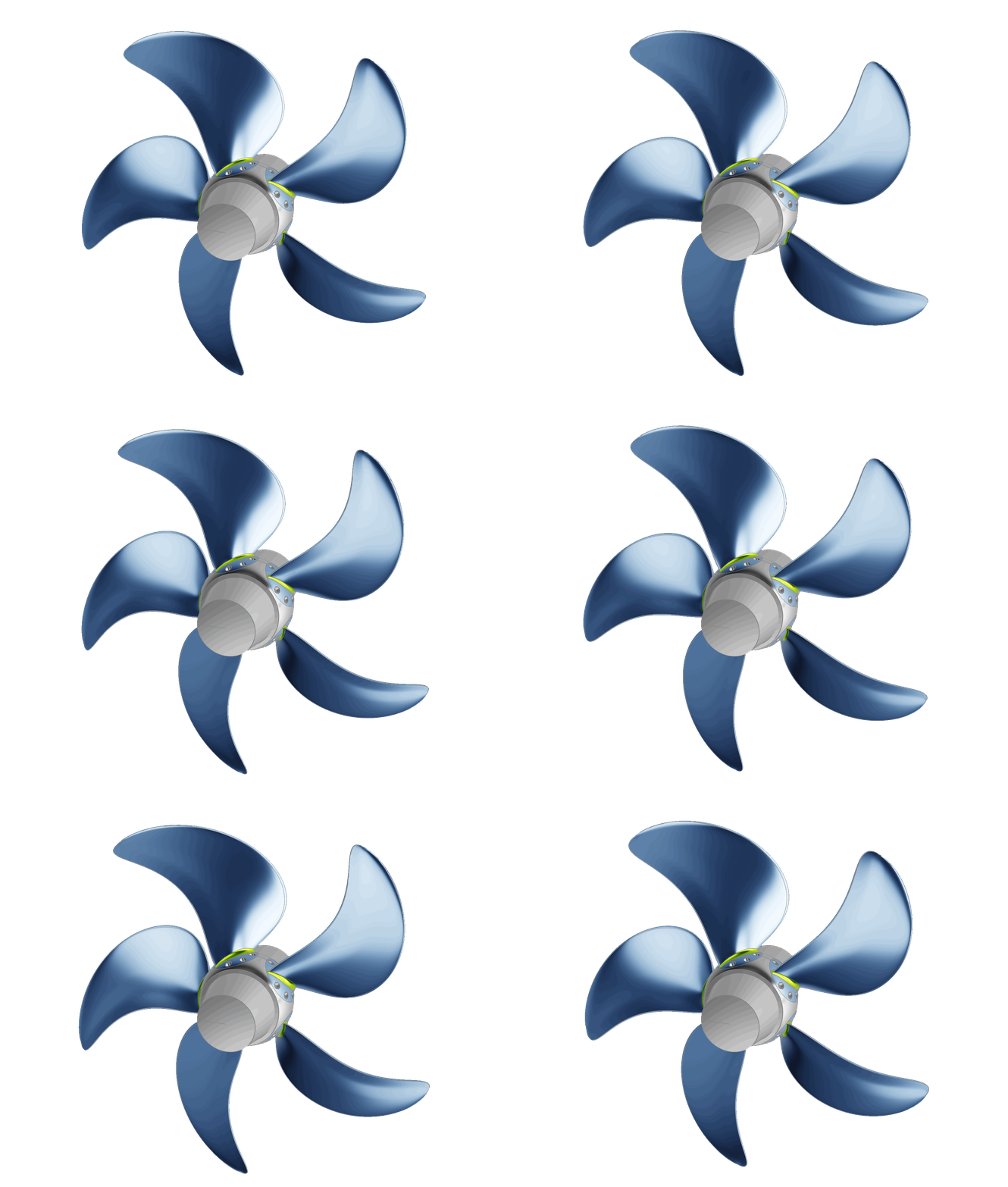
Robust variation
High robustness and flexibility of parametric models for reliable automated design studies and optimization.
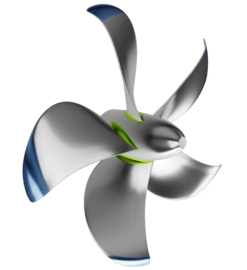
Tips and fillets
Dedicated functionality to close propeller tips with a smooth surface, as well as for the fillet creation between hub and blade (fixed and variable-radius fillets).
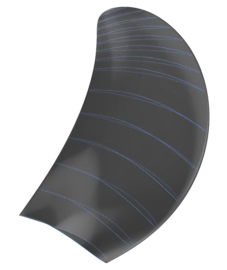
Specialized formats
Ability to import and write specialized formats, such as PFF files.
Read in ASCII files with your sectional data and automatically generate a parametric propeller model including tip and hub with a single click. Such a model is ready for being manufactured, but also for further studies in combination with CFD and stress analysis.
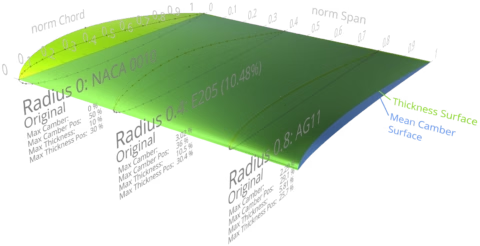
Airfoil definitions
Create custom parametric airfoil definitions and control them using radial parameter distribution functions, or import airfoil point data from a database, interpolate, and parameterize as needed.
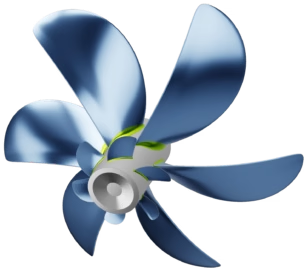
Geometry add-ons
Include energy-saving or noise reducing features such as propeller boss cap fins, serrations, anti-singing edges, or tip fences.
Workflow integration
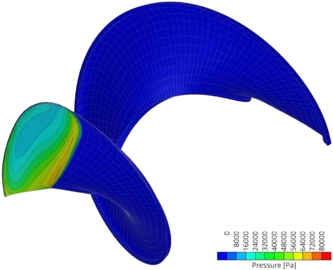
Full interfacing to external analysis, such as CFD or structural analysis.
Generation of simulation domains, including potential flow panel meshes and geometry-adapted support structures for volume meshing.
Interested in a specific capability?
Contact usWhat our customers say

“In our experience, using CAESES for creating parametric models was MUCH faster and easier than with our traditional CAD tool – hours versus weeks! For complex geometries, the traditional CAD tool was not the optimum solution because when creating variants we experienced a lot of infeasible geometries, whereas in CAESES we had almost 100% success. At Sirehna, CAESES has become an indispensable tool for conducting comprehensive shape optimization studies in an automated CFD-driven design process.”
Pol Muller
Head of Thrusters

“CAESES is a core component in the design department, and nowadays, it drives all new product developments to ensure the very best performance.”
David Bendl
Development Engineer
Getting started
-
Use sample model
Start with a sample model.
See our samples -
Browse documentation
Browse the documentation to learn more.
Read documentation -
Free trial
You can try CAESES for free for 2 weeks.
Get free trial -
Contact us
Contact us to discuss your challenge.
Contact us
FAQs
Can CAESES optimize marine propeller designs?
Yes. CAESES is widely used to create fully parametric propeller models and automate optimization studies. Parameters such as pitch distribution, chord, skew, rake, camber, and thickness can be varied automatically to improve efficiency, cavitation behavior, and propulsion performance.
Why use parametric modeling for propeller design?
Parametric modeling allows designers to rapidly generate consistent propeller variants while preserving manufacturable geometry. Combined with CFD simulations, this enables efficient exploration of the design space and faster identification of optimal propeller configurations.
What is parametric geometry modeling?
Parametric geometry modeling allows engineers to control geometry using variables, rules, and dependencies. In CAESES, geometry automatically updates when parameters change, enabling rapid design exploration and optimization.
Is CAESES only useful for CFD applications?
No. While CAESES is widely used for CFD-driven optimization, it is simulation-agnostic. It can be integrated with structural, thermal, acoustic, electromagnetic, manufacturing, and multidisciplinary simulation workflows.