Simulation- and data-driven turbomachinery blade design
Explore and optimize blade geometries through parametric geometry variation, automated simulation workflows, and multidisciplinary design studies.
Why choose a simulation- and data-driven design approach?
Accelerated design space exploration
Simulation-driven design enables engineers to evaluate thousands of blade geometries and operating conditions virtually, identifying high-performing concepts much faster than traditional sequential design processes. This shortens development cycles while expanding the range of design alternatives that can be explored.
Higher aerodynamic efficiency and performance
Simulation-based optimization helps refine blade geometries to achieve objectives such as increased efficiency, higher pressure ratio, reduced losses, and improved flow uniformity. The result is turbomachinery that delivers better performance while meeting demanding design constraints.
Better understanding of complex flow physics
Large simulation datasets provide detailed insight into phenomena such as flow separation, secondary flows, tip leakage, and shock interactions. These insights enable engineers to make more informed design decisions and develop more robust, high-performance blade designs.
CAESES’ blade design capabilities
CAESES is a specialized CAD and automation tool for optimizing complex, performance-critical geometries, with dedicated capabilities that make it particularly suited for the design of cutting-edge bladed turbomachinery components.
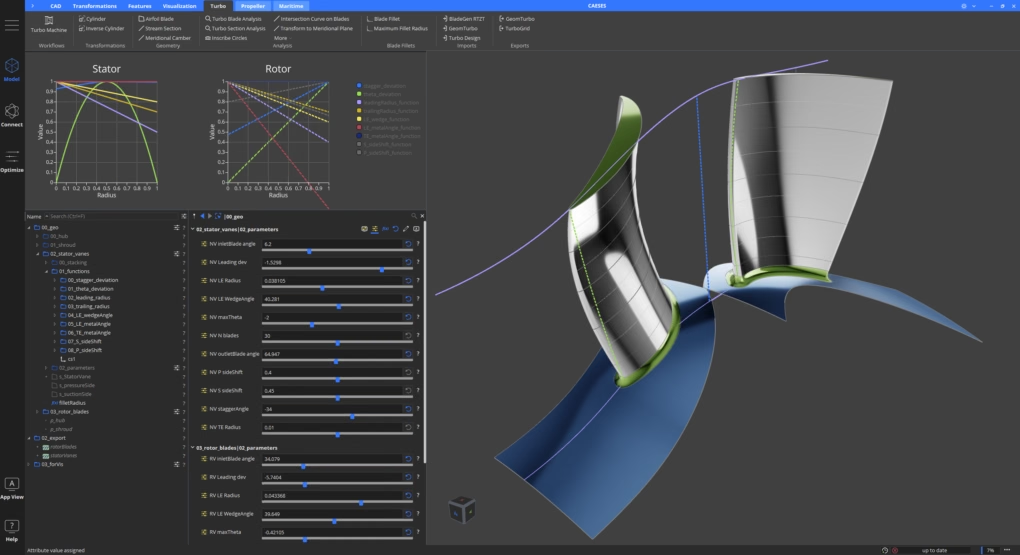
Smart parametric modeling
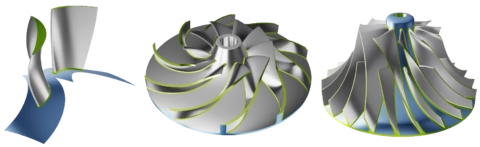
Complete parametric blade modeling capabilities for radial, axial, and mixed flow rotors and stators.
Control of the blade shape via discrete parametric cross sections, continuous control via radial parameter distribution functions, or customized modeling approaches, e.g., for radially fibered or flank milled blades.
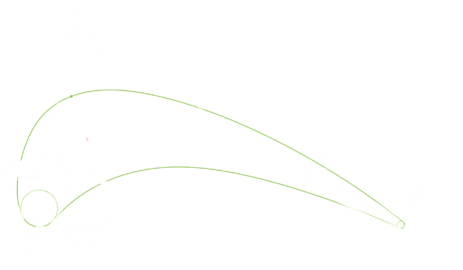
Axial machines
Angle and shape preserving transformations for axial machine airfoil modeling.
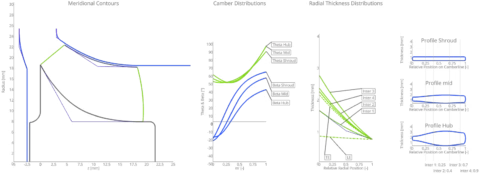
Radial machines
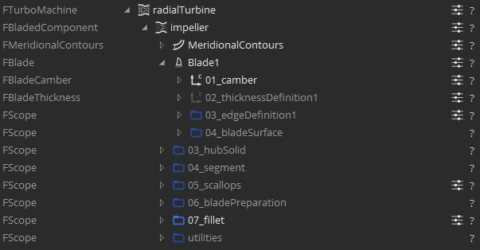
Flexible control of blade, wrap angle and thickness distributions for radial impellers.
Intuitive yet customizable
Dedicated modeling workflows for turbomachinery greatly simplify the process.
Yet, high level of customization, i.e., no black box models and full freedom to set up user-defined parameterizations and workflows.
Robust variation
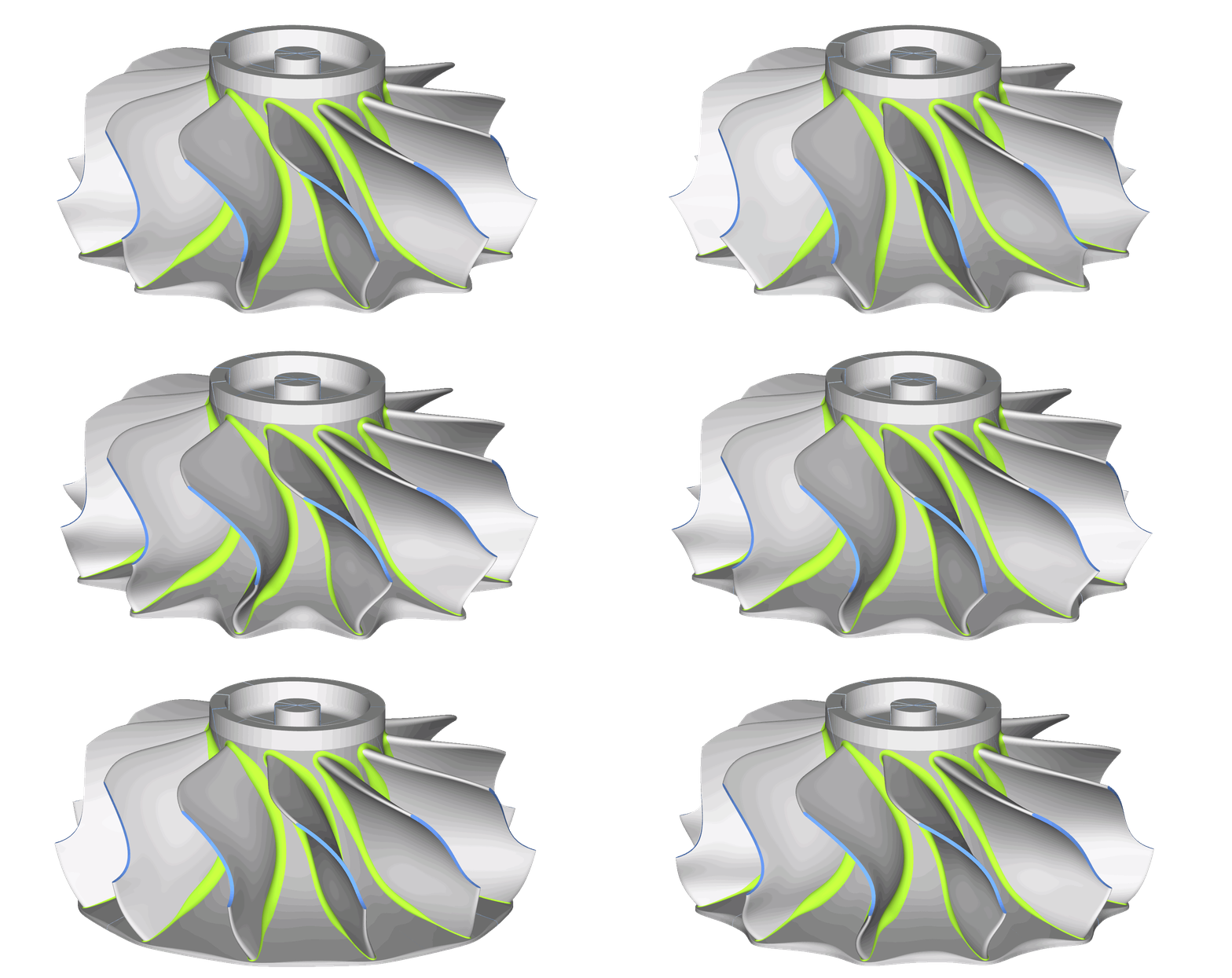
High robustness and flexibility of parametric models for reliable automated design studies and optimization.
Detail oriented
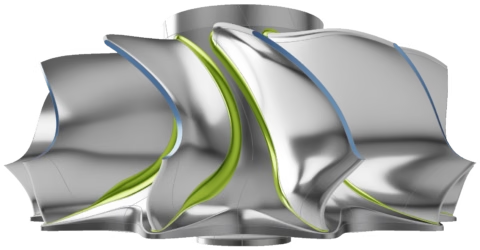
Comprehensive tuning possibilities of shape details like root fillets, scalloping, leading edges, and blade tips.
Constraint handling
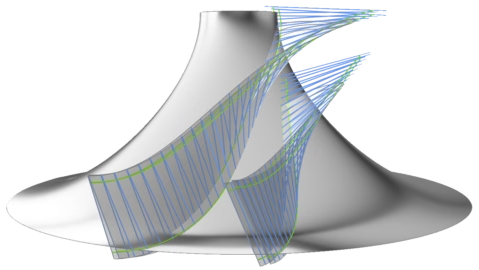
Full consideration and integration of manufacturing constraints (e.g., flank milling, casting, additive manufacturing).
Flexible interfacing
Import and processing of geometry data from external preliminary design tools and special export formats for turbomachinery like geomTurbo or Turbogrid.
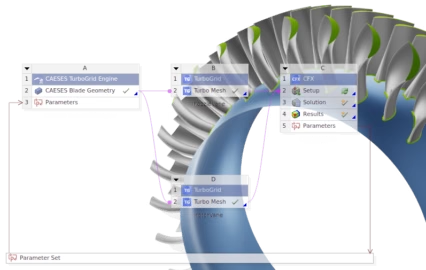
Direct integration in ANSYS Workbench through CAESES Workbench apps.
Interested in a specific capability?
Contact usWhat our customers say

“By using CAESES, we could massively bring down our turbine design cycle from several months to only a few weeks.”
Nicolas Lachenmaier
Engineer for Fluid Dynamics and Thermal Analysis

“We launched a pilot project with FRIENDSHIP SYSTEMS to evaluate CAESES in May, it helped us solve a time-critical task in July and it became a design tool by October.
By then, we had created flexible and robust parametric models for complex parts, enabling us to optimize in design spaces we had previously not been able to explore.”
Tilman auf dem Kampe
Head of Aerodynamics Technology Development Large Gas Turbine Engineering

“I enjoy using CAESES, as it allows me to parametrically generate geometries without ever going through a CAD design cycle.
In this sense, it really streamlined my process from concept to CFD verification.”
Ruhou Gao
Turbomachinery Engineer

“I have successfully been using CAESES for many years now. It allows me to create my own customized toolbox with everything I need in the different stages of the pump design process.
The functionality of CAESES greatly accelerated and complemented our traditional design process. Finally, it lets us improve the quality of our various types of pumps.”
Toni Klemm
CFD Engineer
Getting started
-
Use sample model
Start with a sample model.
See our samples -
Browse documentation
Browse the documentation to learn more.
Read documentation -
Free trial
You can try CAESES for free for 2 weeks.
Get free trial -
Contact us
Contact us to discuss your challenge.
Contact us
FAQs
How is CAESES used for turbomachinery blade optimization?
CAESES provides flexible parameterization of compressor, turbine, pump, and fan blades, enabling automated optimization based on CFD simulations. Engineers can investigate blade shape variations to improve efficiency, pressure ratio, flow capacity, or other performance objectives.
Can existing blade geometries be optimized with CAESES?
Yes. Existing blade designs can be imported, analyzed, parameterized, or morphed, allowing engineering teams to enhance proven designs while preserving important geometric characteristics and reducing development effort.